
Happy World Read Aloud Day, UK! Today, February 4th, 2026, marks this global celebration of the joy and power of reading aloud, founded by LitWorld back in 2010 to champion literacy as a human right and spark connections through stories.
It feels especially pertinent this year, with 2026 declared the National Year of Reading by the Department for Education and the National Literacy Trust, there’s a real push to help everyone; children, families, and communities rediscover (or discover for the first time) the pleasure of reading in whatever form works best.

Here in the UK, our literary heritage runs deep, stretching back more than 1,400 years across successive eras of English literature; from Old English epics like the anonymous Anglo-Saxon poem Beowulf (composed c. 700–1000 AD) to modern global blockbusters such as J.K. Rowling’s Harry Potter series (over 600 million copies sold worldwide).
Supported by enduring institutions, massive worldwide readership, and international acclaim, this tradition evolved with Geoffrey Chaucer’s The Canterbury Tales (late 14th century), which helped legitimise vernacular English over Latin or French for serious literature. William Shakespeare (1564–1616), author of 37 plays and 154 sonnets, produced works that remain among the most performed and studied in history. The 19th century brought the powerful voices of the Brontë sisters; Charlotte, Emily, and Anne, whose novels Jane Eyre (1847), Wuthering Heights (1847), and The Tenant of Wildfell Hall (1848) offered ground-breaking explorations of passion, independence, and social constraint, earning enduring global admiration and countless adaptations. Victorian novelists like Charles Dickens created socially influential bestsellers; such as Oliver Twist and A Christmas Carol, that drove reforms and sold hundreds of millions of copies worldwide (with A Tale of Two Cities exceeding 200 million).
In the 20th century, George Orwell’s 1984 and Animal Farm shaped political discourse, while J.R.R. Tolkien’s The Lord of the Rings and The Hobbit (combined sales estimated at over 250 million copies) redefined fantasy literature. The UK has also produced multiple Nobel Prize in Literature laureates, including Rudyard Kipling (1907), T.S. Eliot (1948), Winston Churchill (1953), and others, cementing its place as a powerhouse of global storytelling.
Rediscover why reading aloud isn’t just educational, it’s magical, especially in a world where screens often steal the spotlight.
Time to dust off our favourite books, or pick up a brand new one (love the smell) and let the words take you away…

The Alarming State of Literacy in the UK
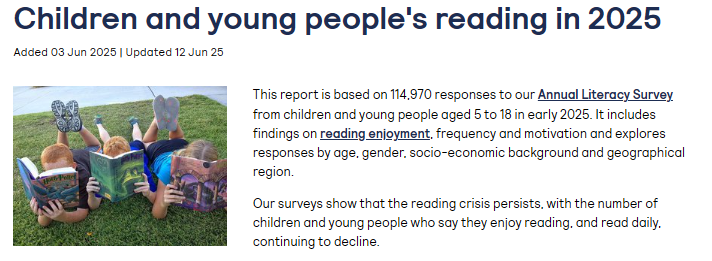
The latest figures from the National Literacy Trust’s 2025 Annual Literacy Survey; based on responses from over 114,000 children and young people aged 5 to 18, found that just 1 in 3 (32.7%) of 8-to-18-year-olds say they enjoy reading in their free time. This is the lowest level since tracking began in 2005, representing a 36% drop over two decades. Daily reading in free time has halved, with only 1 in 5 (18.7%) doing it regularly.
Among younger children (5 to 8), daily reading stands at 44.5%, down from previous years. There’s a clear sex-based gap too: girls state they enjoy reading more (39.1%) than boys (25.7%), and the decline hits the hardest amongst older boys. These aren’t just statistics, they’re a real concern for learning, wellbeing, and progression throughout life. Children who enjoy reading tend to perform better across subjects, show stronger empathy and confidence, and experience better mental health. The National Literacy Trust describes this as a “social justice” issue, and the National Year of Reading 2026 aims to turn things around by encouraging people to “Go All In” on reading that fits their lives.
In my view, this isn’t a social justice issue; it’s a profound educational and values issue. If we fail to teach literacy properly and nurture inquisitive, thoughtful minds, we risk raising generations who are disengaged, less able to question, imagine, or think critically; a nation sleepwalking through life rather than actively engaging with it.
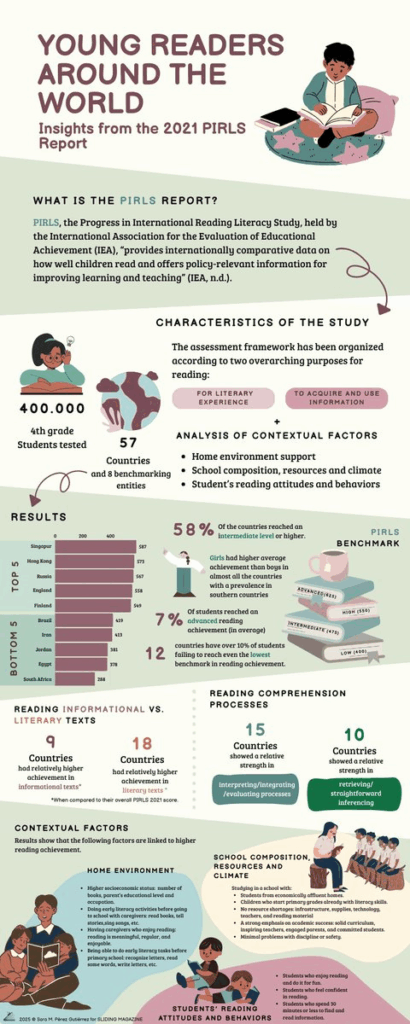
International data from studies like PIRLS (Progress in International Reading Literacy Study, focused on 9–10-year-olds) and PISA (Programme for International Student Assessment, for 15-year-olds) show that declining reading enjoyment is a widespread issue in many developed countries, but the UK often ranks below international averages on attitudes despite solid or above-average achievement scores.
Globally, about 42% of fourth-graders “very much like reading,” 40% “somewhat like,” and 18% “do not like.” England performed strongly in reading achievement (often above average), but attitudes lagged: only 29% of pupils “liked reading” (vs. international median ~46%), and 24% did not enjoy it (vs. global ~18%). This placed England and Northern Ireland below the international average on enjoyment.
Why Reading Aloud is Vital for Learning
As someone who used to teach, I know first-hand the impact of a good story in the classroom, I know reading aloud works wonders. It’s one of the most accessible ways to support language development, and research strongly backs this up. This simple practice exposes children to rich vocabulary, narrative structures, imaginative scenarios, and complex ideas, helping build foundational skills for literacy, comprehension, and critical thinking. Research consistently shows that regular read-aloud sessions stimulate areas in the brain linked to language processing, memory, visual imagery, and attention, while also fostering emotional regulation and social understanding through discussions about characters’ feelings and motivations. The Education Endowment Foundation highlights interactive shared reading as a high-impact approach in early years, helping build vocabulary, comprehension, and a love of books. When adults read aloud, pausing for questions, using voices, or pointing out pictures, strengthen listening skills, and develop a deeper understanding of language and stories, children pick up new words (often at a rate of 1–2 per minute).
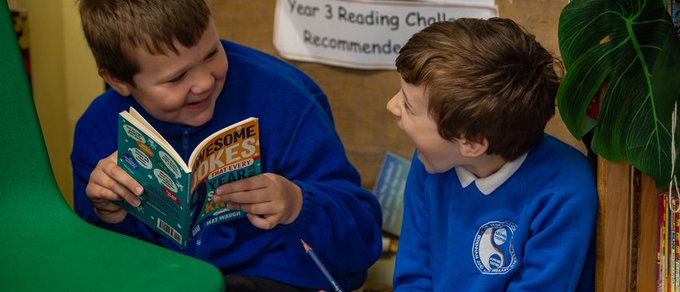
The National Literacy Trust emphasises that reading aloud to young children boosts talking and listening, grows vocabulary, and lays foundations for literacy. It provides comfort, reassurance, and fun, while also helping children process emotions and build empathy. Even for older children and teens, shared reading can reduce isolation and spark interest in books. In my experience across subjects, a well-chosen read-aloud moment could engage a whole class, make complex ideas accessible, and create those lightbulb moments that stick.
Jean Piaget’s theory of cognitive development provides a valuable framework for understanding why reading aloud is particularly beneficial at different ages, as it aligns with how children’s thinking evolves through four distinct stages. Piaget emphasised that children actively construct knowledge through interaction with their environment, and shared reading offers a structured yet engaging form of interaction that scaffolds this process.
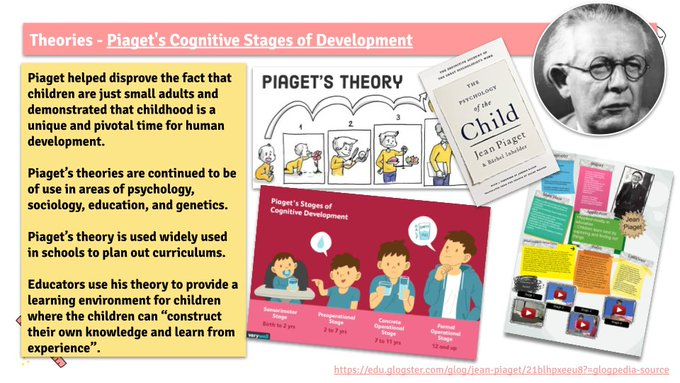
- Sensorimotor stage (birth–2 years): Infants think by interacting with the world using their eyes, ears, hands, and mouth. Reading aloud during this stage, through rhythmic language, rhymes, board books with high-contrast images, and the use of known and interesting voices, stimulates sensory experiences, building early language associations, and supporting emerging object permanence and memory as babies begin to anticipate repeated phrases or turn pages.
- Preoperational stage (2–7 years): Development of language and make-believe play takes place and evolves rapidly. Reading aloud introduces symbolic thinking through stories, encouraging pretend play (e.g., acting out tales); expanding a child’s vocabulary dramatically. It enables children to explore concepts like cause-and-effect or emotions in a safe, narrative context, bridging their egocentric, intuitive thinking toward a more logical understanding.
- Concrete operational stage (7–11 years): Children’s reasoning becomes logical providing the issues are concrete, children may be able to understand simple logical principles. At this stage, reading aloud with chapter books, nonfiction, or stories involving real-world problems supports logical reasoning by providing children with more and more concrete examples, encouraging predictions, inferences, and discussions about sequences, comparisons, and conservation concepts embedded in plots.
- Formal operational stage (11–18 years +): This is when the capacity for abstract thinking allows adolescents to reason through symbols that do not refer to objects in the real world, as is required in advanced mathematics. Reading aloud (or shared reading of more complex texts) continues to benefit teens by exposing them to abstract themes, hypothetical scenarios, ethical dilemmas, and sophisticated language, promoting hypothetical-deductive reasoning, critical analysis, and the ability to consider multiple perspectives or “what-if” possibilities.
Though there are critics of Piaget, some valid criticisms, the key takeaway from his theory is that learning and gaining intelligence is an active process, not passive.
Practical Tips for Reading Aloud at Home or in the Classroom
To make the most of reading aloud, start simple and build from there. Choose books that match the listener’s interests; whether it’s dinosaurs for toddlers, adventures for primary school age, or dystopian novels for teenagers, to keep engagement high. Set aside dedicated time, like 10-15 minutes daily, free from distractions. Use expressive voices for characters, vary your tone and pace to build suspense, and incorporate gestures or props for added fun. Pause frequently to ask open-ended questions like “What do you think will happen next?” or “How does that make the character feel?” This encourages interaction and deeper comprehension.

For families, make it a ritual, such as bedtime stories; in schools, integrate it into circle time or as a transition activity. Remember, it’s not about perfection, stumbling over words shows that reading is a skill everyone practices. Resources like the National Literacy Trust’s booklists or LitWorld’s WRAD toolkits can provide age-appropriate recommendations and activity ideas.
Celebrating World Read Aloud Day 2026 in the UK: Events and Initiatives
This year’s World Read Aloud Day theme, “Celebrate Learning,” perfectly aligns with the UK’s National Year of Reading 2026. Over 173 countries also participate globally, but in the UK, the focus is on community events that combat the declining enjoyment of reading.
Key activities include virtual author visits, school read-aloud marathons, and family story sessions at libraries. The National Literacy Trust is kicking off the year with National Storytelling Week (February 2-8), featuring free online events on February 3rd-4th, including storytelling workshops and “Go All In Together” moments to share stories across schools and settings. Local libraries and bookshops often host pop-up read-aloud sessions, check the Go All In website for events near you, such as those at Arsenal FC’s launch or parliamentary invitations highlighting school-library partnerships.
To join in, register for LitWorld’s global read-aloud challenge, share your sessions on social media with #WRAD2026, or volunteer through the National Year of Reading to lead community readings. Upcoming tied events include World Book Day on March 5, with quizzes and book tokens to make reading accessible and fun. https://storyvoice.scholastic.com/landing
The Broader Benefits: Reading Aloud for All Ages
While much focus is on children, reading aloud benefits adults too. It strengthens family bonds, reduces stress (studies show it lowers heart rates more than silent reading), and even supports elderly care by stimulating memory and conversation in care homes. In workplaces or book clubs, shared readings foster team building and empathy. Amid the UK’s literacy challenges, where fewer than half of young children read daily, incorporating aloud sessions can reignite passion across generations, turning reading into a social, joyful habit rather than a solitary chore.
Conclusion: Let’s Go All In on the Joy of Reading Aloud

On this World Read Aloud Day, let’s commit to making 2026 a turning point. Grab a book, gather your loved ones, and let the stories flow, whether it’s a classic like Beowulf retold or a fresh 2026 release from Waterstones’ children’s picks. By celebrating aloud, we’re not just building literacy; we’re creating connections, empathy, and a brighter future. As the National Year of Reading reminds us, if you’re into it, read into it. Happy reading, UK!
References
- Alatalo, T. and Westlund, B. (2021) ‘Early language development and reading aloud with children: A scoping review and content analysis’, ScienceDirect [online]. Available at: https://www.sciencedirect.com/science/article/pii/S2666374025000731 (Accessed: 4 February 2026).
- Beck, I.L. and McKeown, M.G. (2007) ‘Increasing young children’s oral vocabulary repertoires through rich and focused instruction’, The Elementary School Journal, 107(3), pp. 251-271.
- Borgonovi, F. and Montt, G. (2012) ‘Parental involvement in selected PISA countries and economies’, OECD Education Working Papers, No. 73, OECD Publishing, Paris.
- Breadmore, H.L. et al. (2019) ‘Literacy Development: Evidence Review’, Education Endowment Foundation, London.
- Bus, A.G., van IJzendoorn, M.H. and Pellegrini, A.D. (1995) ‘Joint book reading makes for success in learning to read: A meta-analysis on intergenerational transmission of literacy’, Review of Educational Research, 65(1), pp. 1-21.
- Chloe Butlin (2024) ‘EEF blog: The student as apprentice: the power of the “think aloud”’, Education Endowment Foundation [online]. Available at: https://educationendowmentfoundation.org.uk/news/eef-blog-the-student-as-apprentice-the-power-of-the-think-aloud (Accessed: 4 February 2026).
- Christina Clark et al. (2025) ‘Children and young people’s reading in 2025’, National Literacy Trust [online]. Available at: https://literacytrust.org.uk/research-services/research-reports/children-and-young-peoples-reading-in-2025 (Accessed: 4 February 2026).
- Clark, C. and Picton, I. (2025) ‘Children and young people’s reading in Scotland in 2025’, National Literacy Trust [online]. Available at: https://literacytrust.org.uk/research-services/research-reports/children-and-young-peoples-reading-in-scotland-in-2025 (Accessed: 4 February 2026).
- DeBruin-Parecki, A. and Squibb, K. (2011) ‘Promoting at-risk preschool children’s comprehension through research-based strategy instruction’, Reading Horizons, 51(1), pp. 1-22.
- Education Endowment Foundation (2020) ‘EEF Blog: Reading aloud with your class – what does the research say?’, Education Endowment Foundation [online]. Available at: https://educationendowmentfoundation.org.uk/news/eef-blog-reading-aloud-with-your-class-what-does-the-research-say (Accessed: 4 February 2026).
- Education Endowment Foundation (n.d.) ‘The importance of reading in early years education’, Education Endowment Foundation [online]. Available at: https://educationendowmentfoundation.org.uk/early-years/literacy/the-importance-of-reading-in-early-years-education (Accessed: 4 February 2026).
- Fälth, L. (2021) ‘The effects of shared book reading on young children’s vocabulary and phonological awareness’, Early Child Development and Care, 191(10), pp. 1565-1576.
- Fien, H. et al. (2011) ‘An examination of the efficacy of a multitiered intervention on early reading outcomes for first grade students at risk for reading difficulties’, Journal of Learning Disabilities, 44(6), pp. 508-520.
- Gilligan, R. and Wingfield, E. (2025) ‘2026 Year of Reading: The reduction in children and young people reading, is a social justice issue’, University of Birmingham [online]. Available at: https://www.birmingham.ac.uk/news/2025/2026-year-of-reading-the-reduction-in-children-and-young-people-reading-is-a-social-justice-issue (Accessed: 4 February 2026).
- Jones, S. (2024) ‘The power of reading aloud’, Research Schools Network [online]. Available at: https://researchschool.org.uk/town-end/news/the-power-of-reading-aloud (Accessed: 4 February 2026).
- Justice, L.M. et al. (2009) ‘Language experience moderates the effect of explicit instruction on preschoolers’ syntactic knowledge’, Early Childhood Research Quarterly, 24(1), pp. 67-76.
- Kouri, T.A. (2018) ‘The effects of shared reading on vocabulary development in young children’, Journal of Early Childhood Literacy, 18(2), pp. 234-256.
- Lonigan, C.J. and Whitehurst, G.J. (1998) ‘Relative efficacy of parent and teacher involvement in a shared-reading intervention for preschool children from low-income backgrounds’, Early Childhood Research Quarterly, 13(2), pp. 263-290.
- Mol, S.E., Bus, A.G. and de Jong, M.T. (2009) ‘Interactive Book Reading in Early Education: A Tool to Stimulate Print Knowledge as Well as Oral Language’, Review of Educational Research, 79(2), pp. 979-1007.
- Mullis, I.V.S. et al. (2017) PIRLS 2016 International Results in Reading, TIMSS & PIRLS International Study Center, Lynch School of Education, Boston College.
- Murphy, K.A. et al. (2023) ‘The impact of shared book reading on children’s language skills: A meta-analysis’, Educational Research Review, 38, p. 100511.
- National Early Literacy Panel (2008) Developing Early Literacy: Report of the National Early Literacy Panel, National Institute for Literacy, Washington, DC.
- National Literacy Trust (2025) ‘Children and young people’s reading in 2025’, National Literacy Trust [online]. Available at: https://literacytrust.org.uk/research-services/research-reports/children-and-young-peoples-reading-in-2025 (Accessed: 4 February 2026).
- National Literacy Trust (n.d.) ‘Reading for pleasure’, National Literacy Trust [online]. Available at: https://literacytrust.org.uk/reading-for-pleasure (Accessed: 4 February 2026).
- Organisation for Economic Co-operation and Development (2012) PISA 2009 Results: Learning to Learn – Student Engagement, Strategies and Practices (Volume III), OECD Publishing, Paris.
- PBS (2018) ‘Why Reading Aloud to Kids Helps Them Thrive’, PBS [online]. Available at: https://www.pbs.org/parents/thrive/why-reading-aloud-to-kids-helps-them-thrive (Accessed: 4 February 2026).
- Save the Children UK (n.d.) ‘Reading With Your Child: Building Confidence Through Stories’, Save the Children UK [online]. Available at: https://www.savethechildren.org.uk/what-we-do/parent-hub/reading-with-your-child (Accessed: 4 February 2026).
- Seden, J. (2008) ‘Creative connections: Parenting capacity, reading with children and practitioner assessment and intervention’, Child & Family Social Work, 13(2), pp. 133-143.
- Sénéchal, M. and LeFevre, J.A. (2002) ‘Parental involvement in the development of children’s reading skill: A five-year longitudinal study’, Child Development, 73(2), pp. 445-460.
- Simply Psychology (2023) ‘Piaget’s theory and stages of cognitive development’, available at: https://www.simplypsychology.org/piaget.html (Accessed: 4 February 2026).
- Sliding Magazine (2025) ‘Young readers around the world: Insights from the 2021 PIRLS report’, Sliding Magazine, 15 September. Available at: https://slidingmagazine.com/2025/09/15/young-readers-around-the-world-insights-from-the-2021-pirls-report/ (Accessed: 4 February 2026).
- Swanson, E. et al. (2011) ‘A synthesis of read-aloud interventions on early reading outcomes among preschool through third graders at risk for reading difficulties’, Journal of Learning Disabilities, 44(3), pp. 258-275.
- The Guardian (2025) ‘Children’s reading enjoyment falls to lowest recorded level in UK’, The Guardian [online]. Available at: https://www.theguardian.com/books/2025/jun/11/children-reading-enjoyment-falls-national-literacy-trust (Accessed: 4 February 2026).
- University of Virginia School of Education and Human Development (2024) ‘The Many Benefits of Reading for Pleasure’, UVA [online]. Available at: https://education.virginia.edu/news-stories/many-benefits-reading-pleasure (Accessed: 4 February 2026).
- Verywell Mind (2025) ‘Support and criticism of Piaget’s stage theory’, available at: https://www.verywellmind.com/support-and-criticism-of-piagets-stage-theory-2795460 (Accessed: 4 February 2026).
- Waterstones (2025) ‘The Children’s Books You Need to Read in 2026’, Waterstones [online]. Available at: https://www.waterstones.com/blog/the-childrens-books-you-need-to-read-in-2026 (Accessed: 4 February 2026).