
Introduction
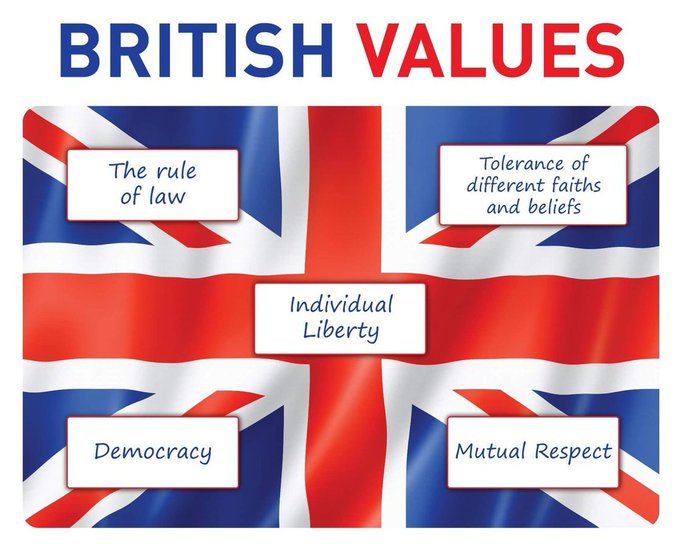
British culture is not a static ethnic inheritance, a government-approved list of “values,” or a matter of skin colour, genealogy, or racial purity. It is a living, adaptive synthesis built over more than two millennia on the islands of Great Britain and Northern Ireland. We are more than the “Fundamental British values”, as defined by the Department for Education and the 2011 Prevent Strategy, include democracy, the rule of law, individual liberty, and mutual respect and tolerance for different faiths and beliefs.
Its defining uniqueness lies in a distinctive combination of pragmatic evolutionary continuity: the repeated absorption of new peoples and ideas without revolutionary rupture, expressed through common-law liberties, an unwritten constitution rooted in precedent, constitutional monarchy as a symbolic thread of stability, empirical pragmatism, stoic understatement (“stiff upper lip”), and a dry, self-deprecating irony that serves as both social lubricant and defence against pomposity.
Britishness is civic-cultural; anyone who masters the language, queues without complaint, laughs at authority with understatement, and respects the rule of evolving law can claim it, regardless of ancestry. It is distinct from ethnicity (shared ancestral identity, such as English or Scottish), race (broad biological groupings), genealogy (specific family bloodlines), or skin colour (a visible but historically variable trait).
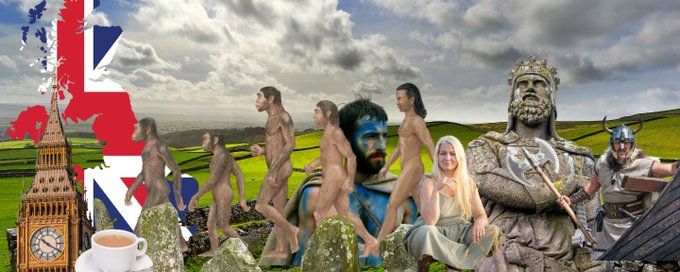
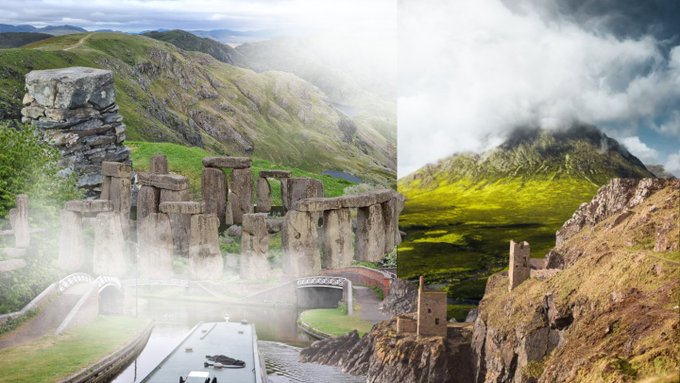
The British Isles themselves; chalk-white cliffs of Dover, misty Highland glens, ancient stone circles on Salisbury Plain, industrial canals of the Midlands, the stunning Pennines, and rugged Cornish coasts, have always been a geographic laboratory for this fusion: isolated enough to develop distinct traits, yet open to successive waves that tested and strengthened the core. This synthesis; tested by geographic isolation fostering distinct traits, and openness to waves of newcomers who strengthened the core without revolutionary rupture. British culture is unlike American individualism, which emphasises personal achievement and optimism, or French rationalism rooted in centralised authority. These distinctions arise from Britain’s island geography, imperial history, and blend of pagan substrates with Christian overlays, setting it apart from continental European formalism (e.g., German) or Mediterranean expressiveness (e.g., Italian).
This article traces that evolution in chronological detail, with nods to origins of traditions, population numbers, genetic realities, and institutional continuity. From prehistoric foundations to the present, integrating political developments, cultural values, and demographic data; to provide clear, evidence-based arguments amid current debates on migration and identity.
I am obviously not in a position to fit the whole of the historical narrative of “Britishness” into one article, however I hope this (fairly in-depth) overview clarifies a few key points! The result, is a cohesive exploration of what makes Britain uniquely British: a resilient hybridity that absorbs change while preserving threads of continuity.
Prehistoric Foundations: Hunter-Gatherers to Neolithic Farmers (c. 950,000 BC – 2,000 BC)
Human presence in Britain dates to the Palaeolithic era, with the earliest evidence around 950,000 years ago at Happisburgh, Norfolk, where flint tools and footprints suggest Homo antecessor (Latin for ‘pioneer man’; now extinct) or erectus (‘upright man’; also now extinct) activity. By 500,000 years ago, Homo heidelbergensis inhabited sites like Boxgrove, Sussex, crafting hand axes and hunting large game. Neanderthals followed between 300,000 and 35,000 years ago, leaving tools amid fluctuating climates.
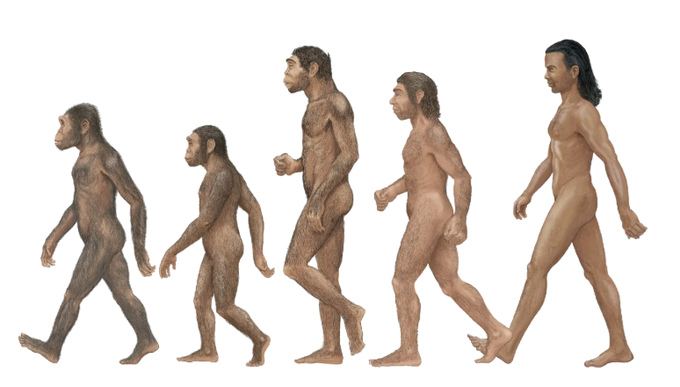
https://www.britannica.com/science/human-evolution
The Mesolithic period (c. 9,000 BC) saw hunter-gatherers adapting to post-Ice Age warming, with birch woodlands spreading. Sites like Star Carr, North Yorkshire, reveal sophisticated wooden platforms and deer antler headdresses, indicating complex rituals. The 8.2 kiloyear event (c. 6,200 BC), a 150-year cold snap from North American glacial lake drainage disrupting ocean currents, tested resilience but did not halt continuity.
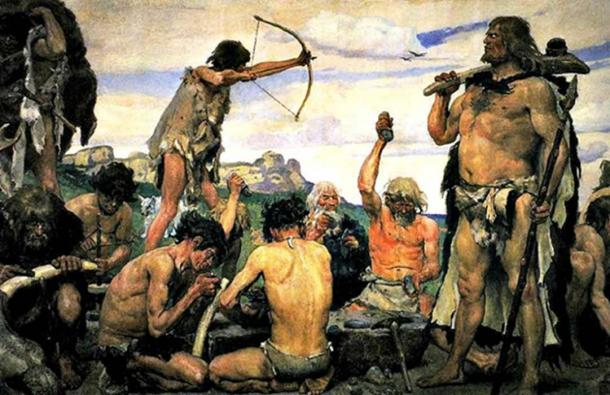
Around 4,000 BC, the Neolithic revolution introduced farming from Anatolian migrants, who carried 80-90% ancestry from local Near Eastern hunter-gatherers with minor Levantine and Caucasian influences. Genetic studies confirm these farmers, blending with local hunter-gatherers (up to 40% in Iberia), replaced most Mesolithic populations in Britain with Aegean-dominant ancestry. They built monuments like Stonehenge (c. 3,000–2,000 BC), aligned to solstices, embodying land-sacred outlooks.
The Beaker culture (c. 2,500 BC) arrived from the Iberian Peninsula, introducing bell-shaped pottery, metallurgy, and trade networks. Graves like the Amesbury Archer near Stonehenge show continental influences, but genetic data reveal steppe ancestry via Central Europe, marking population turnover. These pre-Celtic layers; resilient hunter-gatherers, innovative farmers, and Beaker metallurgists, laid Britain’s cultural mosaic, emphasising adaptability and environmental ties.
Ancient Foundations: The Painted People and Pagan Substrate (Prehistory to c. 325 BC)
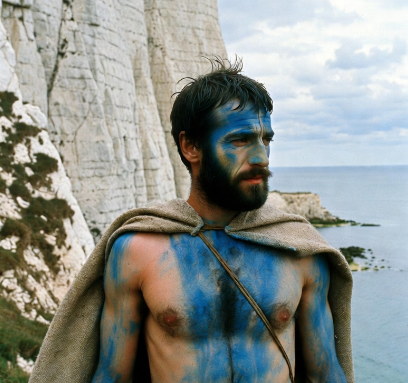
The very name “British” signals hybridity and external layering from its earliest recorded use. Greek explorer Pytheas of Massalia (c. 325 BC) described the inhabitants as Pretani or Pritanī, meaning “the painted ones” or “people of the designs”, referring to the Celtic practice of body-painting or tattooing with woad. The earlier name Albion (recorded by Pliny and others) derives from Proto-Indo-European roots meaning “white,” alluding to the dazzling chalk cliffs visible from the Continent.
These pre-Roman Celtic Britons brought Iron Age sophistication (arriving in waves from c. 600 BC onward) and practised a sophisticated paganism: Druid-led ceremonies in sacred oak groves, veneration of ancestors and nature spirits, and a calendar tied to the agricultural and solar cycles. Festivals included Beltane (1st May: fire rituals for spring fertility and purification, driving cattle between flames) and Samhain (31st October-1st November: the Celtic new year when the veil between worlds thinned, feasting, guising, and honouring the dead).
https://www.ancient-origins.net/news-history-archaeology/90-neolithic-british-gene-pool-was-replaced-beaker-immigrants-009636
Earlier Neolithic and Bronze Age monuments like Stonehenge (aligned to solstices, built c. 3000–2000 BC by pre-Celtic peoples) already embodied this land-sacred outlook. No “pure” British ethnicity ever existed; the islands were a palimpsest (a writing surface; parchment, tablet, or manuscript, that has been scraped or washed clean to be reused, yet still bears traces of the original writing). of Neolithic farmers, Beaker migrants, and Celtic arrivals. Pagan practices were not a rigid religion but a seasonal rhythm of the land. Ronald Hutton’s seminal works demonstrate that while organised Druidic paganism did not survive intact into the Middle Ages, its symbolic and folkloric DNA endured through pragmatic Christian overlay. Many traditions we still celebrate originated or were deeply influenced here: May Day (maypoles, Morris dancing, May Queen processions) echoes Beltane’s fire and fertility rites; Halloween derives from Samhain’s guising and bonfires (later All Hallows’ Eve); harvest suppers and well-dressing carry pre-Christian echoes of thanksgiving to the land. This pagan substrate provided the first template of adaptability: the culture absorbed external pressures by folding them into existing seasonal rhythms rather than erasing them. On a population of perhaps 1–2 million by the Iron Age, this layered identity set the tone for all that followed.
Roman Overlay: Infrastructure, Syncretism, and Multinational Empire (43–410 AD)
The Roman conquest under Emperor Claudius (43 AD) introduced the next major layer. Britain became a province of a vast, multi-ethnic empire; legions and auxiliaries included troops from North Africa, the Middle East, and continental Europe. Roman Britain was never a mass settler colony; estimates suggest the total population remained around 2–4 million, with Romans and their families a small administrative elite, but it left permanent infrastructure: straight roads (many still in use), towns with forums and baths (e.g., Londinium, Camulodunum), aqueducts, and Latin-derived legal concepts that seeded later common law.
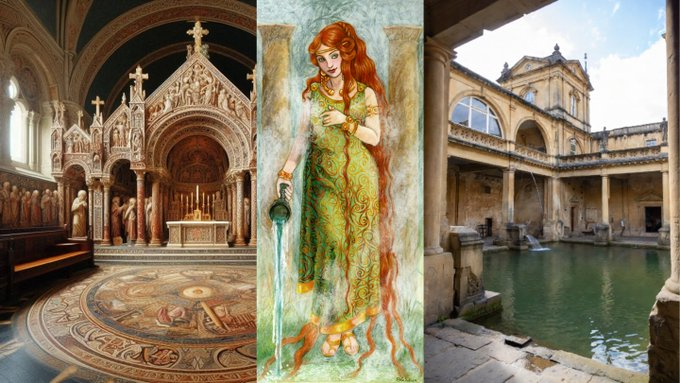
Pagan Celtic deities syncretised (Syncretism is the blending, merging, or amalgamation of different cultures, religions, or philosophical traditions into a new, unified whole. Often occurring through interaction or migration, it allows for distinct beliefs, rituals, or ideas to mix; such as combining indigenous practices with introduced religions, to form unique, hybrid traditions) with Roman ones in a classic British fusion: the goddess Sulis (local healing deity of the hot springs) merged with Minerva at Bath, creating the temple complex that still stands today.
Christianity arrived late in the period (4th century), but rural pagan practices persisted spreading through trade, merchants, and imperial policy after Constantine’s Edict of Milan (313 AD) legalised it empire-wide. By the late 4th century, Romano-British Christianity was organised with bishops in major centres like London and York, though pagan beliefs lingered, especially in rural areas. Roman withdrawal in 410 AD; prompted by pressures elsewhere in the crumbling Western Empire, left roads, villas, and urban planning that post-Roman Britons continued to use rather than abandon, though there was a period, known as the “Dark ages” where there was a regression. Contemporary accounts (e.g., Tacitus in Agricola) portray the Britons as fierce but the fusion was pragmatic: the islands absorbed imperial administration without losing their underlying Celtic substrate. This era reinforced the emerging British trait of selective adoption, taking useful structures (roads, law) while retaining local spiritual rhythms. Christianity persisted in British society, evidenced by 5th-century Christian cemeteries and inscriptions bearing Christian symbols, even as urban life began to contract.
The Sub-Roman/Dark Ages Transition: Regression, Continuity, and Fragmentation (c. 410–600 AD)
The period immediately following Roman withdrawal, often called the “Dark Ages” or sub-Roman Britain (roughly 5th–6th centuries), marked a significant regression in many aspects of organised life. Urban centres collapsed sharply: most Romano-British towns entered a post-urban phase by the mid-5th century, with abandonment, ruin, or timber reconstruction replacing stone buildings. Market activity ceased, coin supply ended, specialised production (pottery, mosaics, metalwork) declined or vanished, and long-distance trade networks broke down.
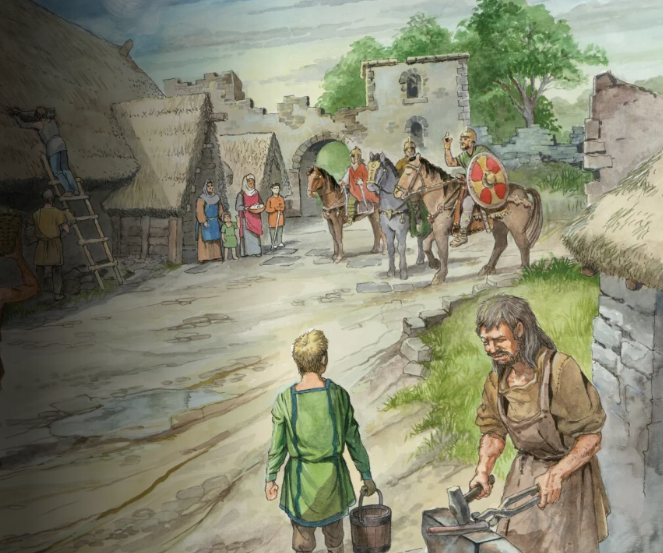
Population likely fell dramatically; from perhaps 3–4 million in late Roman times to half or less, due to factors including environmental changes (Late Antique Little Ice Age), plagues (including the Plague of Justinian arriving c. 544–545), smallpox outbreaks, warfare, and reduced agricultural surplus. Rural life continued, often at subsistence level, with woodland regeneration in some areas and shifting settlements.
Politically, Britain fragmented into small Celtic/British kingdoms based on tribal identities, with local warlords or “tyrants” (as criticised by Gildas in the 6th century) filling the power vacuum. Raids by Picts, Scots (from Ireland), and emerging Germanic groups intensified insecurity. Christianity survived in the western and northern British zones (e.g., Wales, Cornwall, Strathclyde), with Celtic Christianity flourishing in monasteries like Glastonbury and influenced by Irish missions (St Patrick, born into a Romano-British Christian family c. late 4th/early 5th century, evangelised Ireland).
Pagan practices continued in rural areas, and some temples were refurbished early in the period before gradual replacement by churches on the same or nearby sites. This era was not total darkness; literacy and Roman education lingered among elites (evidenced in writings of Patrick and Gildas), and some continuity of Roman heritage persisted in language, law fragments, and Christianity. However, the regression was real: state capacity withered, urbanism declined steeply (faster in Britain than elsewhere in the West), and written records became scarce, earning the “Dark Ages” label. Mass migrations of Britons to Brittany (Armorica) occurred in waves (c. 450s–530s), carrying Celtic culture and Christianity across the Channel. Into this fragmented landscape came Anglo-Saxon migrations (from c. 430s onward), initially as mercenaries invited to defend against raiders, later rebelling and settling in the east and south.
Anglo-Saxon, Viking, and Early Medieval Fusion: The Largest Genetic Layer (5th–11th Centuries)
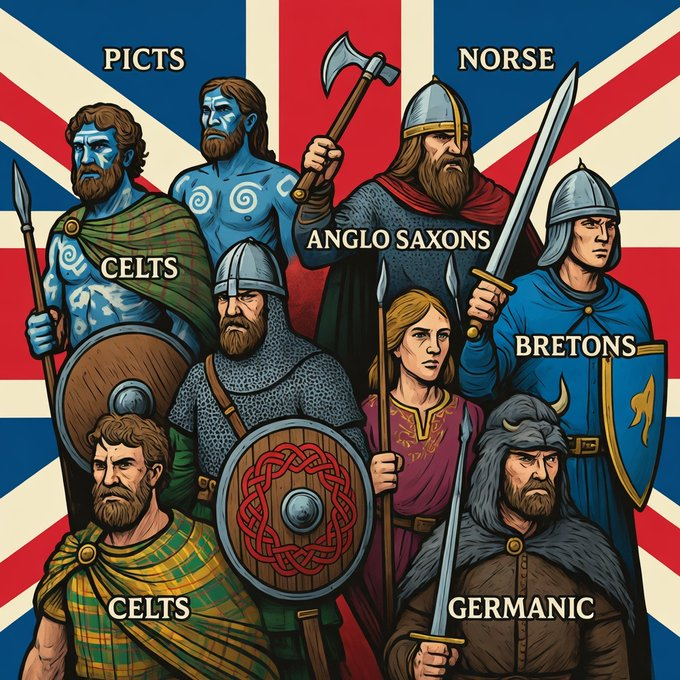
The most transformative demographic shift in English history occurred with Anglo-Saxon migrations (c. 400–800 AD) from northwest Germany, Denmark, and the Low Countries. Ancient DNA research on 460 medieval skeletons (Gretzinger et al., 2022) reveals that eastern England derived up to 76% ancestry from this North Sea Germanic zone in early medieval samples, settling at an average 25–40% contribution across modern England (with regional variation; Wales and Scotland retained stronger Celtic continuity). On a post-Roman population already reduced, this influx was proportionally massive; far exceeding most later waves in relative impact. The newcomers brought their Germanic language (the core of modern English), pagan pantheon (Woden, Thor, Tiw, Frig, preserved in Tuesday, Wednesday, Thursday, Friday), and seasonal rites such as Yule (midwinter feasting, evergreens, and the return of light).
Viking raids and settlements (8th–11th centuries) added the Danelaw in the north and east, contributing up to 4–8% genetic input in affected regions, along with Norse place names and legal customs. Christianity gradually converted the population (St Augustine’s mission 597 AD onward), but the Church was pragmatic: it Christianised existing festivals rather than banning them outright. Yule became Christmas (12 days of feasting, evergreens, gift-giving); Ēostre’s spring goddess rites fed into Easter eggs and hares as symbols of renewal; Samhain influenced Halloween. Morris dancing and maypoles, rooted in earlier pagan fertility customs, survived despite later Puritan disapproval.
By the 11th century, the fusion of Celtic substrate, Germanic tongue, and Christian overlay had produced the early English gene pool and cultural DNA. Britons initially feared these “barbarian” invaders, yet the layered result became the foundation of what we now recognise as Englishness within Britishness; pragmatic resilience born of necessity.
Norman Conquest and the Birth of Constitutional Continuity (1066–1500s)
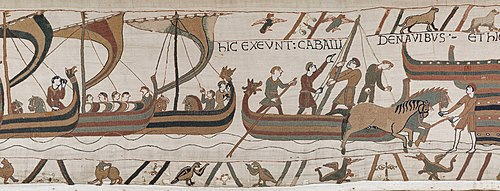
The Norman invasion of 1066 brought a small but elite French-speaking force (estimates 2–5% of England’s ~2 million population). Contemporary chroniclers decried them as foreign tyrants, yet their descendants forged Magna Carta (1215); the first written check on monarchical power, guaranteeing liberties such as no arbitrary imprisonment and trial by peers. This seeded the common-law system: judge-made, precedent-based, jury-centred, and emphasising individual freedom (“an Englishman’s home is his castle”) over continental codified law. The unwritten constitution evolved incrementally through the Bill of Rights (1689) and parliamentary sovereignty, avoiding the violent resets seen elsewhere in Europe.
Arthurian legends blended Celtic pagan echoes with Norman chivalry. Population remained modest; change was institutional rather than mass-replacement. By the 1300s, Middle English “Breteyne” and “British” entered usage, reflecting the hybrid identity. This era cemented the British genius for evolutionary adaptation: absorbing a conquering elite’s language and feudalism while producing the legal framework that still underpins liberty under law.
Reformation, Puritan Interlude, Empire, and the Hardening of Character (1500s–1945)
Henry VIII’s break with Rome (1530s) and the Protestant Reformation spurred mass literacy through the King James Bible (1611) and empirical science (Francis Bacon’s inductive method, Newton’s Principia 1687). The short-lived Puritan Commonwealth (1649–1660) under Oliver Cromwell; following the Civil War and Charles I’s execution, imposed austere rule: theatres banned, bear-baiting prohibited, Morris dancing and maypoles suppressed as “pagan” or sinful, and strict Sabbath enforcement. On a population of ~5 million, this decade of godly authoritarianism was deeply unpopular and reversed at the Restoration (1660), when Charles II reopened theatres and courts embraced wit and excess. Puritan self-discipline contributed to later work ethic and individualism (feeding the Industrial Revolution), but it was an aberration, not the root of British stoicism or humour. The backlash instead amplified ironic satire (Swift, Austen, Wilde) and self-deprecating deflation of authority (later Monty Python).
The British Empire (peaking in the 19th century) and the world’s first Industrial Revolution exported common law, English language, parliamentary models, and sports (cricket, football, golf with medieval Scottish origins) while importing goods, ideas, and smaller migrant waves. Huguenot Protestants (~50,000 refugees, roughly 1% of England’s population by 1700) brought silk-weaving and finance skills amid anti-foreigner riots, yet integrated fully. Victorian “stiff upper lip”, stoic endurance, hardened through imperial hardships and two world wars. Kipling’s “If” encapsulated the ideal of measured resilience. Each layer added without erasing the pagan-to-Christian-to-Protestant thread or the core traits of pragmatic evolution and wry humour.
Political System: From Monarchy to Democracy
Britain’s parliamentary system has a long and gradual evolution, beginning with Anglo-Saxon Witan councils and developing into the modern constitutional monarchy we see today. A pivotal moment came in 1215 with the Magna Carta, which for the first time limited the power of the monarch. Several of its clauses remain in force, including those protecting church freedoms (Clause 1), certain city liberties (Clause 9), and the right to due process (Clause 29). In the 13th century, representation began to broaden. Simon de Montfort’s parliament in 1265 included not only nobles but also knights and burgesses, laying early groundwork for the House of Commons. This was formalised further with the Model Parliament of 1295 under Edward I, which established a more structured system of representation from different parts of society.
The principle of parliamentary supremacy was firmly entrenched during the Glorious Revolution of 1688. The Bill of Rights that followed curbed royal authority and confirmed Parliament’s dominant role in governance. Around this time, organised political parties began to emerge: the Whigs (later evolving into Liberals) and Tories (later Conservatives). Sir Robert Walpole, serving from 1721 to 1742, is widely regarded as Britain’s first Prime Minister, marking the rise of the office as the effective head of government.
The 19th century brought significant electoral reforms. The Reform Act 1832 extended the vote to much of the propertied middle class, beginning to address long-standing inequalities in representation. This period also saw the rise of Chartism (1836–1848), a working-class movement that demanded six key reforms through the People’s Charter: universal male suffrage, secret ballot, no property qualifications for MPs, payment for MPs, equal electoral districts, and annual parliamentary elections. Although massive petitions; such as the one in 1842 with over 3 million signatures, were rejected by Parliament at the time, five of the six demands (all except annual elections) were eventually achieved by 1918.
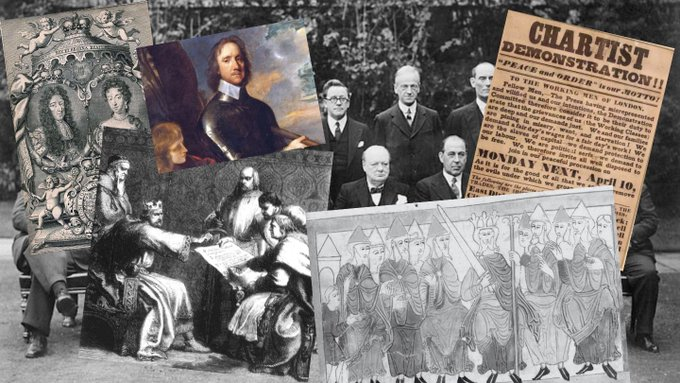
Parallel campaigns advanced women’s suffrage. Peaceful suffragists, such as Millicent Fawcett and Lydia Becker, lobbied through lobbying and education. In contrast, the militant suffragettes of Emmeline Pankhurst’s Women’s Social and Political Union (WSPU, founded 1903) employed direct action, including public disruptions, property damage, and hunger strikes to draw attention to their cause. These efforts, and the impact of the First World War on a “woman’s place”, culminated in the Representation of the People Act 1918, which granted the vote to women over 30 who met property qualifications (as well as all men over 21). Full equality came with the 1928 Act, which removed the age and property distinctions for women.
Today, the UK uses the First-Past-The-Post (FPTP) system to elect its 650 Members of Parliament (MPs). Under FPTP, the candidate with the most votes in each constituency wins the seat, regardless of whether they achieve an absolute majority. This system tends to produce stable governments with clear parliamentary majorities and maintains a strong link between MPs and their local constituencies. However, it is often criticised for disproportionality. For example, in the 2024 general election, Labour won about 33.7% of the national vote but secured roughly 63.2% of the seats (411 out of 650), creating a large majority on a relatively modest share of the popular vote. Critics highlight issues such as “wasted” votes for losing candidates, encouragement of tactical voting, underrepresentation of smaller parties and minority views, and the risk of “false majorities” where a party governs with less than 50% support. Overall, while FPTP offers simplicity and decisive outcomes, debates continue about whether it adequately reflects the diversity of voter opinion in a modern democracy.
Post-War Acceleration to the Present: Unprecedented Pace Meets Enduring Thread (1945–2025)
Post-1945 Commonwealth migration and the sharp post-1990s rise produced the fastest demographic shift in the last millennium. The 2021 Census (England & Wales) recorded 16% foreign-born nationally (10.7 million across the UK), with White British identification at 74.4% (44.4 million, down from 80.5% in 2011 and 87.5% in 2001). Net migration drove nearly all recent population growth on a ~67–68 million base; peaks reached 906,000–944,000 in 2022–23 before provisional figures for the year ending June 2025 showed a sharp fall to 204,000 (immigration 898,000 minus emigration 693,000).
Urban changes are stark; London White British fell to 37%. Cumulative net inflows since the late 1990s total several million; unprecedented in absolute scale and speed compared with the entire previous 1,000 years, when waves like the Normans (2–5%) or Huguenots (~1%) occurred on far smaller populations. Concerns about dilution and replacement are rooted in this measurable rapidity: services strained, parallel communities emerging where integration lags, and visible demographic transformation within two decades. Yet history counters despair.
The Anglo-Saxon influx was proportionally larger yet produced the culture we value. Pagan festivals survived Christian conversion; Germanic language absorbed Norman French; common law and parliamentary continuity evolved through every shock. Britishness is the transmission of institutions, humour, and fair play, not just genealogy or skin colour.
Newcomers who adopt queuing, ironic banter, respect for precedent, and affection for the monarchy become British; those forming enclaves do not. The 2025 net migration drop to 204,000 provides breathing space for confident cultural re-assertion. In the beautiful British Isles, from Stonehenge’s solstice gatherings (echoing ancient pagan alignments) to Christmas markets rooted in Yule, from parliamentary debates tracing to Magna Carta to Saturday football crowds, the thread of quiet reinvention holds. The culture does not dilute; it deepens when the pace allows the core to be passed on.
Britishness Distinct from Ethnicity, Race, Genealogy, and Skin Colour
Conflating these categories fuels misunderstanding.
- Race vs Ethnicity: In everyday UK speech people often use them interchangeably, but officially they are not the same. Ethnicity is the statistical/self-ID term; race is the legal term that explicitly includes colour and nationality. The Census deliberately uses only “ethnic group” to avoid the older, more biological-sounding word “race”. Self-identified ethnicity/race is a social and cultural construct that includes non-genetic factors. Genetic ancestry is purely biological and shows real, measurable population structure.
- Ethnicity refers to ancestral group feeling (English, Welsh, Scottish heritage). In the UK context, there is no singular “British ethnicity” in the way there is English, Scottish, or Welsh ethnicity. Britishness is not typically treated as an ethnicity; instead, people often identify ethnically as English/Welsh/Scottish (or with diaspora/heritage groups like British Indian, British Pakistani, Black British, etc.). “White British” is a common census category, but it reflects a broad ethnic grouping based on European descent within the UK; not a requirement for Britishness. Unlike race, ethnicity emphasises cultural rather than primarily phenotypic markers, though ancestry narratives are often part of the story.
- Race is a loose biological cluster. Race emerged in the 18th century to support colonialism and slavery; it is not rooted in biology but in social mechanisms for grouping Europeans, Africans, and Indigenous peoples in colonial contexts. Therefore it is based on a social construct of perceived physical differences (especially skin colour, facial features), historically used to categorise people into broad groups (e.g., White, Black, Asian). It has limited biological basis; human genetic variation is continuous, not clustered into discrete races, but it carries significant social and historical weight due to racism and discrimination. Race is distinct from nationality/citizenship: A Black British person, Asian British person, or White British person all hold the same nationality.
- Genetic vs Genealogical: DNA tests measure genetic ancestry; family trees measure genealogical. They overlap but are not identical. One traces specific family lineages, ancestry, and the other DNA inheritance; often through records, family trees, or genetic testing (e.g., autosomal DNA, Y-chromosome, mtDNA). It can reveal detailed personal heritage (e.g., percentages of DNA areas; English, Irish, Scandinavian, or distant African/Asian ancestry), but it does not define Britishness. Genetic studies show regional patterns (e.g., slight differences between northern vs. southern Britain) Genetic ancestry is the objective, measurable proportion of an individual’s DNA inherited from ancestral populations in specific geographic/ historical regions, inferred from genome-wide markers (SNPs) via tools like PCA, admixture analysis, or reference panels. It reflects real biological relatedness and population structure due to historical isolation, migration, and drift
- Skin colour varies it is a phenotypic trait influenced by genetics, environment, and adaptation (e.g., lighter skin in northern latitudes for vitamin D synthesis). It has varied historically in Britain: Early post-Ice Age inhabitants (e.g., ~10,000 years ago, like Cheddar Man) likely had darker skin. Ancient Europeans (including pre-Celtic populations) with lighter pigmentation became more common in the last ~3,000–5,000 years. Celtic-speaking peoples historically were paler, with variations, darker Roman auxiliaries from North Africa and the Mediterranean are included in the modern admixture continuing the ancient pattern.
- Other related terms commonly confused in UK debates;
- Nationality = Legal citizenship (can be multiple or changed). Part of legal “race” but not the same as ethnicity.
- National origins = Where your ancestors came from (legal ethnicity/ race protection).
- Colour = Visible phenotype (skin, hair, etc.). Explicitly protected under race.
In short: Ethnicity = who you feel you are (UK stats). Race = legal shield covering colour + ethnicity + nationality (UK law). Genetic ancestry = what your DNA actually says about ancestral populations (UK science/ medicine). Genealogy = your paper-trail family history.
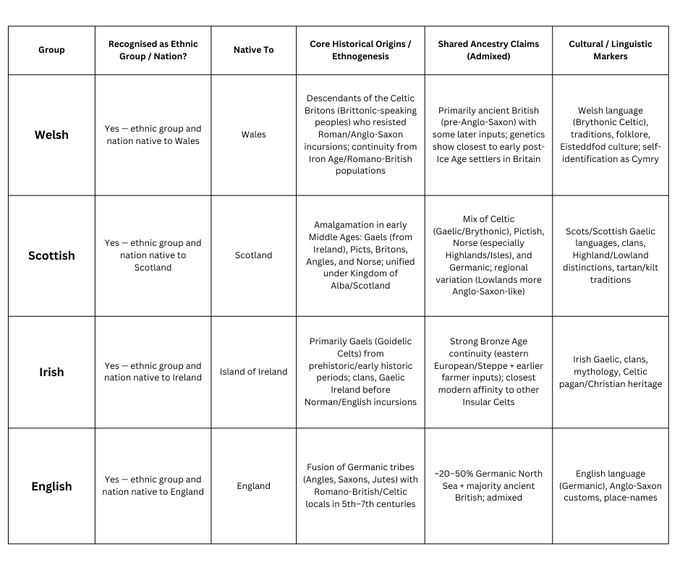
British culture’s bedrock is paganism, absorbed into Christian/Protestant matrices, yielding seasonal rhythms and folk wit. Britishness transcends these categories: it is the acquired cultural inheritance of pragmatic liberty-under-law, understated endurance tested in empire and war, and humour that punctures pretension (from Chaucer to Blackadder). The deepest pagan layer proves resilience: even the “dilution” of old gods into Christian festivals left seasonal rhythms and folk wit intact. Every past “invasion” panic (Anglo-Saxons as barbarians, Normans as oppressors, Huguenots as job-stealers) produced the very traits we now know to be British. The current pace is new in raw numbers, but the absorption mechanism; evolutionary, not revolutionary, is the same. Those worried by change have legitimate historical precedent on their side when demanding managed integration that preserves the unique hybrid thread.
Purity was never the recipe; the stirring process, rooted in these islands’ geography and history, is what makes Britishness enduringly distinct.
So… to Re-cap “What makes British Culture Unique”:
Historically grounded traits that distinguish British culture from, say, American individualism, French rationalism, or German formalism. British culture is the adaptive, layered identity of the British Isles’ peoples:
Christianity (especially its Protestant Reformation expression in Britain) is the pervasive historical matrix that helped crystallise and sustain these traits; reinforcing resilience, empiricism, limited authority, and moral seriousness, without becoming a separate “British” marker like the others. Britain’s uniqueness lies in domesticating Christianity pragmatically: absorbing it (from Celtic to Roman to Protestant forms) without the revolutionary enthusiasms or rigid theocracies seen elsewhere. It fused with pagan substrates, Stoic influences (Christianised in Britain), and island pragmatism to produce a reserved, ironic, evolutionary culture rather than dogmatic or ecstatic one. Christianity is a core historical driver behind British Culture.
Paganism is the deepest foundational layer of British culture; not a footnote, but the bedrock that everything else was built on and still draws from. Christmas is from Yule, Easter from Ēostre, Halloween from Samhain etc, all carry the DNA. British culture didn’t “lose” its paganism; it absorbed it so thoroughly that the island’s seasonal rhythm, sense of the land as sacred, and wry folk humour still pulse with it.
Stoicism & reservedness (“stiff upper lip”): Forged in wartime and imperial endurance (“keep calm and carry on,” “grin and bear it”). Public emotion is restrained; private resilience prized. Kipling’s poem captures the ideal of self-discipline amid adversity.
Dry, ironic, self-deprecating humour: A communication tool and coping mechanism. Understatement, sarcasm, satire (Swift’s A Modest Proposal, Shakespeare, Monty Python). It punctures authority, class, and pomposity without direct confrontation; unique in its gentle cruelty and universal target (including the monarchy itself).
Empiricism & pragmatism: Observation over theory (Bacon, Locke, Hume, Newton, Darwin). Common law embodies this: case-by-case, precedent-driven. Institutions evolve incrementally (Magna Carta to the Bill of Rights 1689 to the modern parliamentary sovereignty).
Monarchy as living continuity: Constitutional, symbolic, not absolute. Coronations at Westminster Abbey, Trooping the Colour, royal folklore (ravens at the Tower), a thread of stability across 1,000+ years of change, without the republican resets elsewhere.
Fair play, class awareness & equity tensions: Historical stratification (north/south, urban/rural) tempered by merit, diligence, and distaste for boasting (“tall poppy syndrome”). Rural nostalgia persists (gardens, country cottages, town-country literary tension in Austen, Hardy, Dickens).
Politeness mixed with informality: “Sorry,” queuing, reserve; yet humour allows bluntness. Regional diversity (English/British overlap, Scottish/Welsh dual identities) under a shared framework.
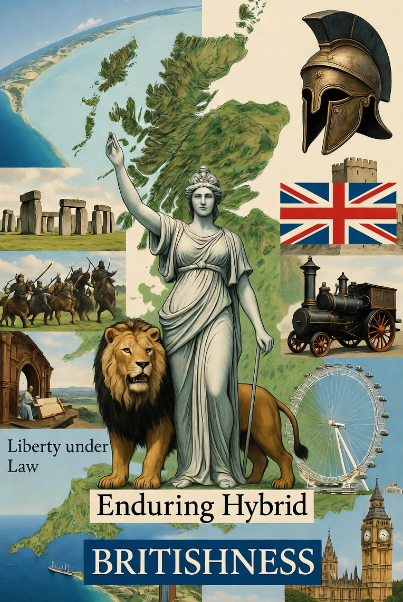
Britishness is enduring hybrid adaptability, rooted in islands’ geography and history. From prehistoric resilience to modern democracy. More than cups of tea, queues, or roast beef, it is a culture of quiet reinvention: absorbing outsiders and shocks without losing its core thread of liberty-under-law, dry wit, and measured progress. It has exported its language, literature, law, and sports worldwide precisely because it never demanded purity, only pragmatic evolution. That hybrid adaptability, born of painted ancients and tested across invasions and oceans, is what makes British culture distinctly, enduringly British.
Reference List
- American Anthropological Association (AAA) Executive Board (1998) ‘AAA Statement on Race’, American Anthropologist, 100(3), pp. 712–713. Available at: https://doi.org/10.1525/aa.1998.100.3.712
- American Association of Biological Anthropologists (AABA) (2019) ‘AABA Statement on Race & Racism’, American Journal of Biological Anthropology, 169(3), pp. 400–402. Available at: https://doi.org/10.1002/ajpa.23882 Also available at: https://bioanth.org/about/aaba-statement-on-race-racism (Accessed: 15 March 2026).
- BBC History (n.d.) Archaeological insights into Palaeolithic and Mesolithic Britain. Available at: https://www.bbc.co.uk/history/ancient/archaeology/
- BBC History (n.d.) Anglo-Saxons. Available at: https://www.bbc.co.uk/history/ancient/anglo_saxons/
- Britannica (n.d.) Model Parliament. Available at: https://www.britannica.com/topic/Model-Parliament
- Britannica (n.d.) Mumming play. Available at: https://www.britannica.com/art/mumming-play
- British Library (n.d.) Magna Carta. Available at: https://www.bl.uk/magna-carta
- Byrne, R.P. et al. (2018) ‘Insular Celtic population structure and genomic footprints of migration’, PLOS Genetics, 14(1), e1007152. Available at: https://doi.org/10.1371/journal.pgen.1007152
- Cannadine, D. (2017) The British Isles: A History. London: Allen Lane.
- Cassidy, L.M. et al. (2015) ‘Neolithic and Bronze Age migration to Ireland and establishment of the insular Atlantic genome’, Proceedings of the National Academy of Sciences, 113(2), pp. 368–373. Available at: https://doi.org/10.1073/pnas.1518445113
- Colley, L. (2005) Britons: Forging the Nation 1707–1837. 3rd edn. New Haven: Yale University Press.
- Coward, B. (2003) The Cromwellian Protectorate. Manchester: Manchester University Press.
- Daily Mail (2024) Tens of thousands of Britons back calls to make St George’s Day a Bank Holiday. Available at: https://www.dailymail.co.uk/news/article-13339457/thousands-brits-call-st-georges-day-bank-holiday.html
- Electoral Commission (n.d.) Electoral System. Available at: https://www.electoralcommission.org.uk/
- Electoral Reform Society (2024) 2024 General Election Results. Available at: https://election2024.electoral-reform.org.uk/
- English Heritage (n.d.) 1066. Available at: https://www.english-heritage.org.uk/learn/story-of-england/norman/1066/
- English Heritage (n.d.) Pace Egg plays. Available at: https://www.english-heritage.org.uk/easter/act-your-own-pace-egg-play/
- English Heritage (n.d.) Prehistoric monuments. Available at: https://www.english-heritage.org.uk/learn/histories/prehistoric-monuments/
- Equality Act 2010, c. 15. Available at: https://www.legislation.gov.uk/ukpga/2010/15/contents
- García, J.D. (n.d.) ‘Race and Ethnicity’, in Perspectives: An Open Introduction to Cultural Anthropology, 2nd edn. Available at: https://perspectives.americananthro.org/second-edition/Chapters/Race_and_Ethnicity.pdf
- GOV.UK (2014) Sir Robert Walpole (Whig, 1721-1742) History of government. Available at: https://history.blog.gov.uk/2014/11/20/sir-robert-walpole-whig-1721-1742/
- GOV.UK (2026) Migration statistics. Available at: https://www.gov.uk/government/collections/migration-statistics
- Gretzinger, J. et al. (2022) ‘The Anglo-Saxon migration and the formation of the early English gene pool’, Nature, 610(7930), pp. 112–119. Official Nature publication: https://www.nature.com/articles/s41586-022-05247-2 PubMed entry (abstract and links): https://pubmed.ncbi.nlm.nih.gov/36131019/ ResearchGate (often has full PDF via author upload): https://www.researchgate.net/publication/363736520_The_Anglo-Saxon_migration_and_the_formation_of_the_early_English_gene_pool Author correction (if relevant): https://www.nature.com/articles/s41586-022-05429-y Available at: https://doi.org/10.1038/s41586-022-05247-2
- Higham, N. (2004) ‘From sub-Roman Britain to Anglo-Saxon England: Debating the Insular Dark Ages’, History Compass, 2(1).
- Historic UK (n.d.) Picts. Available at: https://www.historic-uk.com/HistoryUK/HistoryofScotland/The-Picts/
- History Extra (n.d.) Vikings in Britain. Available at: https://www.historyextra.com/period/viking/vikings-in-britain/
- Holmes, C. (1988) John Bull’s Island: Immigration and British Society, 1871–1971. London: Macmillan.
- House of Commons Library (n.d.) Magna Carta: Does it still matter?. Available at: https://commonslibrary.parliament.uk/magna-carta-does-it-still-matter/
- Hutton, R. (1991) The Pagan Religions of the Ancient British Isles: Their Nature and Legacy. Oxford: Blackwell.
- Hutton, R. (1996) Stations of the Sun: A History of the Ritual Year in Britain. Oxford: Oxford University Press. Hutton, R. (1996) Stations of the Sun: A History of the Ritual Year in Britain. Oxford: Oxford University Press. Internet Archive (free borrow/stream in some regions; full scan available): https://archive.org/details/stationsofsunhis0000hutt or https://archive.org/details/stationsofsunhis0000hutt_w2i1 Amazon (purchase/preview): https://www.amazon.com/Stations-Sun-History-Ritual-Britain/dp/0198205708 or paperback edition https://www.amazon.com/Stations-Sun-Ronald-Hutton/dp/0192854488
- JenkTeach (n.d.) Exploring the Roots of British Culture: A Brief Journey Through the History and Origins of Britain https://jenkteach.co.uk/exploring-the-roots-of-british-culture-a-brief-journey-through-the-history-and-origins-of-britain/ & https://jenkteach.co.uk/category/articles-blogs-by-jennifer-thetford-kay/
- Laura Devine Immigration (2026) Latest immigration statistics released: net migration falls and business compliance action soars. Available at: https://www.lauradevine.com/news/immigration-statistics-feb-2026-net-migration
- Leslie, S. et al. (2015) ‘The fine-scale genetic structure of the British population’, Nature, 519(7543), pp. 309–314. Available at: https://doi.org/10.1038/nature14230
- Londonist (2025) Where To Celebrate St George’s Day 2025: Special Events In London. Available at: https://londonist.com/london/things-to-do/st-george-s-day-events-in-london
- Migration Observatory (2025) Net migration falls 78% in two years returning to pre-Brexit levels. Oxford: University of Oxford.
- Migration Watch UK (2026) Britain Doesn’t Know The Half of It. Available at: https://www.migrationwatchuk.org/news/2026/02/13/britain-doesnt-know-the-half-of-it
- Morez, A. and Girdland-Flink, L. (2023) ‘Pictish genomes reveal Iron Age continuity and Viking influence in Scotland’, PLOS Genetics, 19(4), e1010695. Available at: https://doi.org/10.1371/journal.pgen.1010695
- Morrill, J. (ed.) (1990) Oliver Cromwell and the English Revolution. London: Longman.
- Nash, C. (2006) ‘Irish origins, Celtic origins: Population genetics, cultural politics’, Irish Studies Review, 14(1), pp. 11–37. Available at: https://doi.org/10.1080/09670880500439760
- National Academies of Sciences, Engineering, and Medicine (2023) Using Population Descriptors in Genetics and Genomics Research: A New Framework for an Evolving Field. Washington, DC: The National Academies Press. Available at: https://doi.org/10.17226/26902
- National Archives (n.d.) British History Timeline. Available at: https://www.nationalarchives.gov.uk/help-with-your-research/research-guides/british-history-timeline/
- National Archives (n.d.) Reform Acts. Available at: https://www.nationalarchives.gov.uk/help-with-your-research/research-guides/reform-acts/
- National Army Museum (n.d.) The ‘Glorious Revolution’. Available at: https://www.nam.ac.uk/explore/army-and-glorious-revolution
- Natural History Museum (2019) Neolithic Britain: Where did the first farmers come from?. Available at: https://www.nhm.ac.uk/discover/news/2019/april/neolithic-britain-where-did-the-first-farmers-come-from.html
- Office for National Statistics (2022) Ethnic group, England and Wales: Census 2021. Newport: ONS. Official bulletin: https://www.ons.gov.uk/peoplepopulationandcommunity/culturalidentity/ethnicity/bulletins/ethnicgroupenglandandwales/census2021 Dataset (detailed ethnic group): https://www.ons.gov.uk/datasets/TS022/editions/2021/versions/1
- Office for National Statistics (2022) International migration, England and Wales: Census 2021. Newport: ONS.
- Office for National Statistics (2025) Long-term international migration, provisional: year ending June 2025. Newport: ONS. Official bulletin: https://www.ons.gov.uk/peoplepopulationandcommunity/populationandmigration/internationalmigration/bulletins/longterminternationalmigrationprovisional/yearendingjune2025 GOV.UK mirror: https://www.gov.uk/government/statistics/long-term-international-migration-provisional-year-ending-june-2025
- Office for National Statistics (2026) Quarterly update on population and migration statistics March 2026. Available at: https://backup.ons.gov.uk/2026/03/04/quarterly-update-on-population-and-migration-statistics-march-2026
- Olusoga, D. (2016) Black and British: A Forgotten History. London: Macmillan. https://www.amazon.com/History-Britain-Edge-World-D/dp/1559276363 (audiobook edition) or related print https://www.amazon.com/History-Britain-Vol-Simon-Schama/dp/0563521090
- Parliament UK (n.d.) History of the House of Lords. Available at: https://www.parliament.uk/business/lords/lords-history/history-of-the-lords/
- Parliament UK (n.d.) History of Parliament. Available at: https://www.parliament.uk/about/living-heritage/evolutionofparliament/
- Parliament UK (n.d.) How Parliament Works. Available at: https://www.parliament.uk/about/how/
- Parliament UK (n.d.) Magna Carta. Available at: https://www.parliament.uk/magnacarta/
- Parliament UK (n.d.) Simon de Montfort. Available at: https://www.parliament.uk/about/living-heritage/evolutionofparliament/originsofparliament/birthofparliament/overview/simondemontfort/
- Parliament UK (n.d.) Suffrage Timeline. Available at: https://www.parliament.uk/about/living-heritage/transformingsociety/electionsvoting/womenvote/
- Parliament UK (n.d.) The Chartist movement. Available at: https://www.parliament.uk/about/living-heritage/transformingsociety/electionsvoting/chartists/overview/chartistmovement/
- Relethford, J.H. (2013) ‘Genetic drift and the population history of the Irish travellers’, Human Biology, 85(1-3), pp. 65–78. Available at: https://doi.org/10.3378/027.085.0305
- Roman Britain (n.d.) Roman Conquest and Occupation of Britain. Available at: https://www.roman-britain.co.uk/roman-conquest-and-occupation-of-britain/initial-claudian-invasion-and-conquest-43-60-ad/
- Schama, S. (2000) A History of Britain, Vol. 1: At the Edge of the World? 3500 BC–AD 1603. London: BBC Books.
- Schama, S. (2001) A History of Britain, Vol. 2: The British Wars 1603–1776. London: BBC Books.
- Schiffels, S. et al. (2016) ‘Iron Age and Anglo-Saxon genomes from East England reveal British migration history’, Nature Communications, 7, 10408. Available at: https://doi.org/10.1038/ncomms10408
- Scotsman (n.d.) The Picts of Scotland explained. Available at: https://www.scotsman.com/heritage-and-retro/heritage/the-picts-of-scotland-explained-3965400
- Seymour Klos, D.A. (2017) Ethnogenesis in Medieval Ireland 800-1366 [Master’s thesis]. University of Southern Mississippi. Available at: https://aquila.usm.edu/masters_theses/344
- Tacitus (c. 98 AD/2009) Agricola and Germania. Translated by J.B. Rives. London: Penguin.
- United Nations General Assembly (2007) United Nations Declaration on the Rights of Indigenous Peoples, Resolution 61/295 adopted 13 September 2007. Available at: https://www.un.org/development/desa/indigenouspeoples/wp-content/uploads/sites/19/2018/11/UNDRIP_E_web.pdf (Accessed: 15 March 2026). Also available at: https://undocs.org/A/RES/61/295
- University of Cambridge (n.d.) Studies on the Beaker culture and population replacement. Available at: https://www.cambridge.org/core/journals/antiquity/article/return-of-the-beaker-folk-rethinking-migration-and-population-change-in-british-prehistory/ABF13307796A0476353FA8D2DA38A21A
- VisaHQ (2026) Net Migration Could Turn Negative in 2026, Raising UK Labour Shortage Fears. Available at: https://www.visahq.com/news/2026-02-15/gb/net-migration-could-turn-negative-in-2026-raising-uk-labour-shortage-fears
- Wilson, J.F. et al. (2001) ‘Genetic evidence for different male and female roles during cultural transitions in the British Isles’, Proceedings of the National Academy of Sciences, 98(9), pp. 5078–5083. Available at: https://doi.org/10.1073/pnas.071036898
English Anthropology and Ethnogenesis:
- The Anglo-Saxon Migration and the Formation of the Early English Gene Pool (Nature) – Peer-reviewed study on English ethnogenesis via DNA, showing 76% continental northern European ancestry from migrations, mixed with local British populations. Available at: https://www.nature.com/articles/s41586-022-05247-2
- British Ethnogenesis: A Late Antique Story (Oxford Academic) – Chapter on early English ethnogenesis in the Late Antique period, focusing on interactions between Britons and Germanic groups. Available at: https://academic.oup.com/book/32058/chapter/267863098
- Anglo-Saxon Immigration and Ethnogenesis (Taylor & Francis) – Article emphasizing the role of native British in English ethnogenesis, with two-phase model of apartheid-like division followed by assimilation. tandfonline.com Available at: https://www.tandfonline.com/doi/abs/10.1179/174581711X13103897378311
- Anglo-Saxon Immigration and Ethnogenesis (ResearchGate PDF) – Detailed model of English formation through migration, acculturation, and native interaction. researchgate.net Available at: https://www.researchgate.net/publication/272308208_Anglo-Saxon_Immigration_and_Ethnogenesis
- Post-Roman Ethnogenesis in Britain (History Forum) – Discussion on English identity as a construct from 5th-century migrations, blending Germanic and local elements. Available at: https://historum.com/t/post-roman-ethnogenesis-in-britain.82623
Irish Anthropology and Ethnogenesis:
- Ethnogenesis and Irish-American Identity on Beaver Island (PDF) – Study on Irish ethnogenesis through interactions with other ethnicities in diaspora contexts. sites.nd.edu Available at: https://sites.nd.edu/irishstories/files/2010/08/Revised-RD-073112.pdf
- Ethnogenesis in Medieval Ireland 800-1366 (Aquila Digital Community) – Thesis on Irish ethnogenesis under English influence, using law and assimilation. Available at: https://aquila.usm.edu/cgi/viewcontent.cgi?article=1344&context=masters_theses
- Irish DNA Originated in Middle East and Eastern Europe (The Guardian) – Article on genetic anthropology showing Irish origins from Stone Age farmers and Bronze Age migrants. Available at: https://www.theguardian.com/science/2015/dec/28/origins-of-the-irish-down-to-mass-migration-ancient-dna-confirms
- Genetic Drift and the Population History of the Irish Travellers (PubMed) – Study on Irish Traveller ethnogenesis, showing distinct origins from Roma but similarity to settled Irish. Available at: https://pubmed.ncbi.nlm.nih.gov/23180293
- Origins of the Irish (Prof James P. Mallory, YouTube) – Lecture on Irish ethnogenesis via ancient DNA, linguistics, and archaeology. Available at: https://www.youtube.com/watch?v=ZdLUcBbYZqU
Scottish Anthropology and Ethnogenesis:
- Wikipedia: Scottish People – Overview of Scottish ethnogenesis from Picts, Gaels, Britons, Angles, and Norse, forming in the Early Middle Ages. Available at: https://en.wikipedia.org/wiki/Scottish_people
- The Unique Look of Scottish People: Heritage & Diversity (House of Argyll) – Anthropological exploration of Scottish ethnic mix from Celtic, Pictish, and Norse roots, with genetic and cultural insights. Available at: https://houseofargyll.com/the-unique-look-of-scottish-people
- The Enigmatic Picts: Where Scotland’s Ethnogenesis is Forged (Substack) – Analysis of Pictish role in Scottish origins, with DNA ties to Iron Age Britons and modern Scots. Available at: https://emancipator1.substack.com/p/the-enigmatic-picts-where-scotlands
- The Ethnological Foundation of the Scottish Enlightenment (YouTube) – Lecture on racial and ethnic ideas in Scottish anthropology during the Enlightenment. Available at: https://www.youtube.com/watch?v=tFq6QBqN4sU
- About Scottish People (Scotland in My Heart) – Historical anthropology tracing Scots from Picts, Celts, and later migrants. Available at: https://scotlandinmyheartsite.wordpress.com/2016/01/09/about-scottish-people
Welsh Anthropology and Ethnogenesis:
- Wikipedia: Welsh People – Comprehensive overview of Welsh ethnogenesis as an ethnic group native to Wales, tracing Celtic Brythonic roots, admixture with Romano-British populations, and cultural/linguistic continuity. Discusses genetic studies showing high retention of pre-Anglo-Saxon ancestry. Available at: https://en.wikipedia.org/wiki/Welsh_people
- Social Anthropologies of the Welsh: Past and Present (WISERD) – Edited collection on Welsh anthropology, exploring identity, language, kinship, and historical ethnography from medieval to modern times. Highlights contributions from scholars like Iorwerth Peate. Available at: https://wiserd.ac.uk/news/social-anthropologies-of-the-welsh-past-and-present
- The Welsh People (Archive.org PDF) – Historical ethnological study from the early 20th century on Welsh origins, including Aryan/Celtic theories and admixture with pre-Celtic groups. Available at: https://archive.org/download/welshpeoplechapt00rhys/welshpeoplechapt00rhys.pdf
- DNA of the Dragon: Wales’ Genetic Journey (YouTube) – Video on Welsh genetic anthropology, linking ancient hunter-gatherers to modern Welsh via archaeology and DNA, emphasizing Celtic connections. Available at: https://www.youtube.com/watch?v=4YquU74jCaM
- A Study of the Welsh People and the Kingdom of Wales (Oreate AI Blog) – Ethnological analysis of Welsh formation around 0 AD, integrating Cymry and Britons through historical evolution. Available at: https://www.oreateai.com/blog/a-study-of-the-welsh-people-and-the-kingdom-of-wales-in-world-ethnic-civilization-history-series/8262e217a07645077bd6afe6e38d7668