

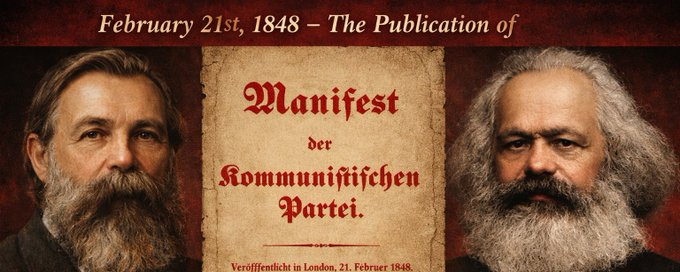
February 21st, 1848, marks the publication of The Communist Manifesto (originally titled Manifest der Kommunistischen Partei, or Manifesto of the Communist Party), a seminal political pamphlet authored by Karl Marx and Friedrich Engels in London.
Commissioned by the Communist League, this 23-page document in German outlined a revolutionary vision rooted in historical materialism, class struggle, and the overthrow of capitalism. Amid the backdrop of the 1848 Revolutions sweeping Europe, it proclaimed that “the history of all hitherto existing society is the history of class struggles” and called for the proletariat to unite against the bourgeoisie. Though its immediate impact was limited due to the revolutions’ failures, it later became one of the most influential texts in history, translated into over 200 languages and shaping global socialist and communist movements.
The Back-Story: Historical Context and Why London?
The Manifesto emerged during a period of profound economic and social upheaval in 19th-century Europe, driven by the Industrial Revolution’s rapid urbanisation, factory labour exploitation, and growing inequality.
Karl Marx, born in 1818 in Trier, Prussia (now Germany), was influenced by Hegelian dialectics, French socialism, and English political economy. After studying law and philosophy, he became a radical journalist, editing the Rheinische Zeitung until its suppression in 1843 due to censorship. Exiled from Prussia, Marx moved to Paris, where he met Friedrich Engels, the son of a wealthy industrialist who shared his critiques of capitalism. Their collaboration began in 1844, with Engels providing financial support and co-authoring works like The Holy Family (1845).
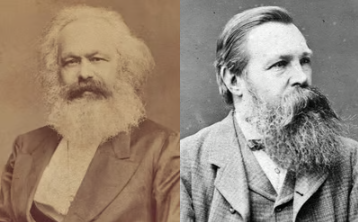
By 1847, both joined the League of the Just (renamed the Communist League), a secret society of German émigré workers in London. The League’s second congress in London (November-December 1847) tasked Marx with drafting a manifesto, building on Engels’ earlier catechism-style drafts like Principles of Communism (A catechism is a summary or exposition of Christian doctrine, traditionally designed as a teaching tool for instruction in the faith, often structured in a question-and-answer format). Marx completed the text in Brussels in January 1848 under pressure, sending it to London for printing.
Why London? Political repression forced Marx’s exile from Belgium in early February 1848, and London offered refuge with its tolerant atmosphere for radicals. The Communist Workers’ Educational Association, based at 46 Liverpool Street in Bishopsgate Without, anonymously printed the first edition amid the brewing Revolutions of 1848. Copies reached Paris by March and Germany by April, but the revolutions’ collapse muted its initial reception.
What the Manifesto Said: Key Ideas and Demands
The Manifesto is structured as a preamble and four sections, blending philosophical analysis with revolutionary calls.
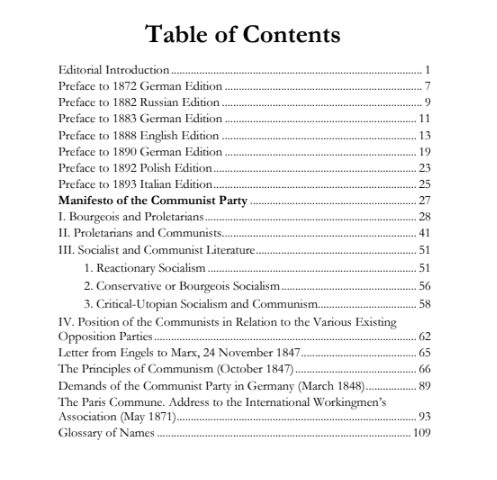
Karl Marx and Frederick Engels – Manifesto of the Communist Party and its genesis Published by the Marxists Internet Archive https://drive.google.com/file/d/186U6J1xdFIsbBpEX14dCGsxDC3KvKyEc/view?usp=sharing
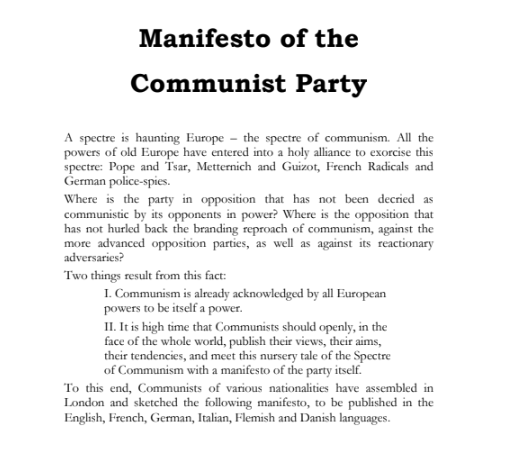
It opens dramatically: “A spectre is haunting Europe—the spectre of communism,” urging communists to openly declare their aims.
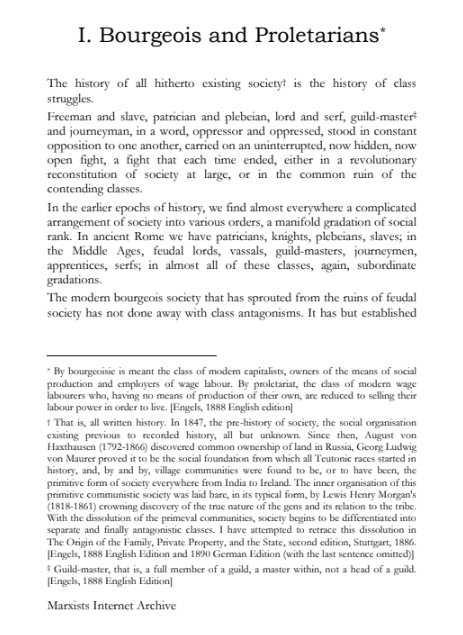
Section I (Bourgeois and Proletarians) applies historical materialism, viewing history as class struggles evolving through modes of production, from primitive communism and feudalism to capitalism. Capitalism, revolutionary in overthrowing feudalism, creates its own gravediggers: the proletariat, alienated and exploited amid globalisation and crises.
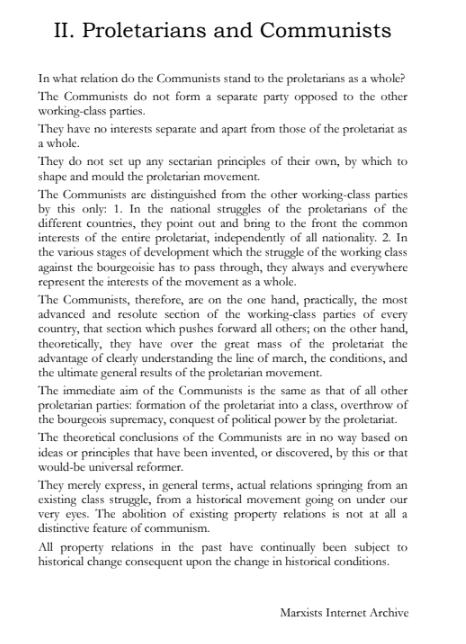
Section II (Proletarians and Communists) defends communism against bourgeois objections, clarifying that communists aim to abolish private property (not personal possessions) and elevate the working class. It lists 10 transitional measures for advanced countries, including progressive taxation, abolition of inheritance, nationalisation of credit and transport, free education, and ending child labour.
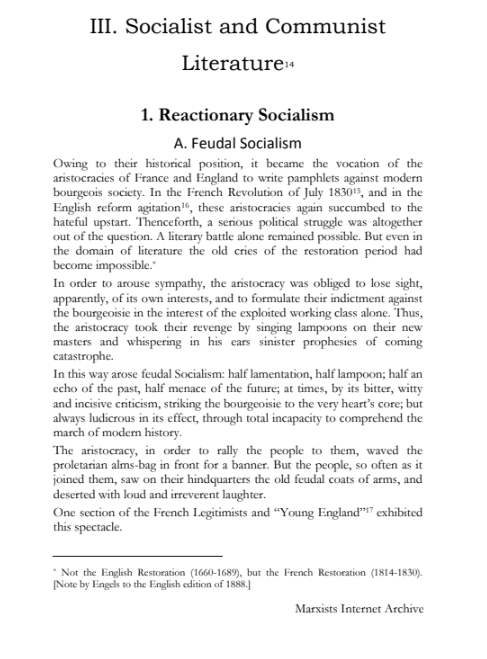
Section III (Socialist and Communist Literature) serves as a critical examination by Karl Marx and Friedrich Engels of various existing socialist and communist ideologies that emerged in the 19th century (Feudal Socialism; reactionary, Petty-Bourgeois Socialism, German or “True” Socialism, Conservative or Bourgeois Socialism, Critical-Utopian Socialism and Communism). Rather than endorsing these as allies in the proletarian struggle, Marx and Engels dissect them as flawed, reactionary, or insufficiently revolutionary alternatives to their own “scientific socialism.” By dismantling these rival socialisms, the Manifesto clears the ideological ground for a unified communist movement, emphasising that half-hearted or backward-looking variants ultimately reinforce bourgeois rule.
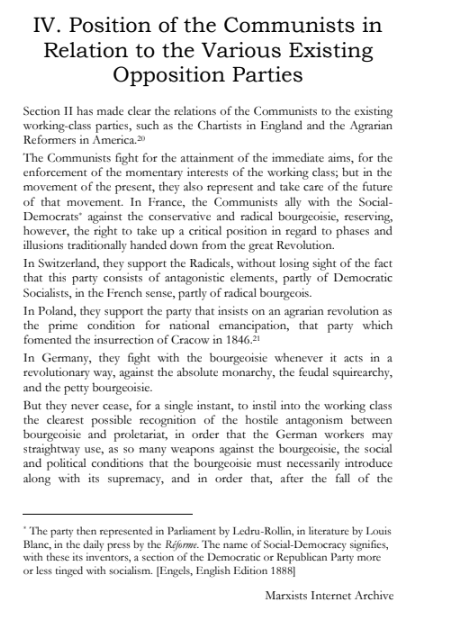
While Section IV Position of the Communists in Relation to the Various Existing Opposition Parties positions communists in ongoing struggles, it outlines the practical political stance of Communists toward other opposition groups in 1847–1848 Europe and beyond. Communists everywhere support every revolutionary movement against the existing social and political order. In all cases, they foreground the property question (abolition of private property in the means of production) as the central issue, no matter the stage of development.
The section ends…
The communists disdain to conceal their views and aims. They openly declare that their ends can be attained only by the forcible overthrow of all existing social conditions. Let the ruling classes tremble at a communistic revolution. The proletarians have nothing to lose but their chains. They have a world to win, and the famous rallying cry: “Working Men of All Countries, Unite!”
The text predicts capitalism’s self-destruction, leading to a classless society where “the free development of each is the condition for the free development of all.” Its ideas drew from Hegel, Feuerbach, and earlier socialists, but Marx inverted Hegel’s idealism into materialism, emphasising economic bases over superstructures.
Karl Marx: An Unpleasant Man Behind the Ideas
While Marx’s intellect shaped revolutionary thought, his personal life reveals a deeply flawed individual. Described as intellectually arrogant, argumentative, and impatient, he alienated allies with crude ridicule. His hygiene was notoriously poor: chain-smoking, excessive drinking, and rare bathing led to boils so severe he couldn’t sit, exacerbated by a chronic skin condition (hidradenitis suppurativa). Financially irresponsible, Marx lived in squalor, racking up debts while sponging off Engels and family.
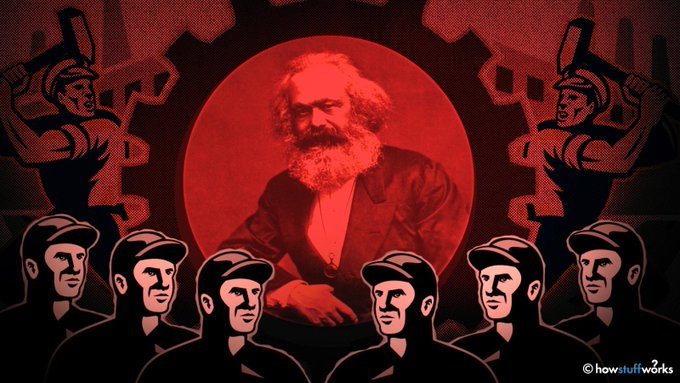
Why Karl Marx Was One of the Most Influential and Destructive Thinkers In History https://history.howstuffworks.com/historical-figures/karl-marx.htm
He fathered seven children, but four died young amid poverty; one son, Edgar, prompted Marx’s outburst at his funeral: “You cannot give me back my boy!” He allegedly impregnated his unpaid housemaid, Helene Demuth, with Engels claiming paternity to avoid scandal. Marx’s anti-Semitic views surfaced in writings, calling Jews “hucksters” and using slurs. His strained family ties; rebelling against his bourgeois parents, and authoritarian temperament mirrored the oppressive regimes his ideas inspired. Biographers note his “power-lusting personality” and contempt for others, painting him as a self-absorbed revolutionary whose personal failings amplified his ideology’s harms.
The Damaging Effects of Communism on the World
Communism, inspired by the Manifesto, has inflicted profound harm since 1917’s Bolshevik Revolution. Estimates from The Black Book of Communism and subsequent research place the death toll at 80-100 million through executions, famines, forced labour, deportations, and imprisonment.
Key examples:
- Stalin’s Soviet Union (20 million, including 11 million from famine/dekulakization and 700,000 in the Great Purge);
- Mao’s China (40-80 million, with 30-55 million from the Great Leap Forward famine and 1-3 million in the Cultural Revolution);
- Pol Pot’s Cambodia (1.5-2 million, a quarter of the population).
- North Korea’s 1990s famine killed up to 3.5 million.
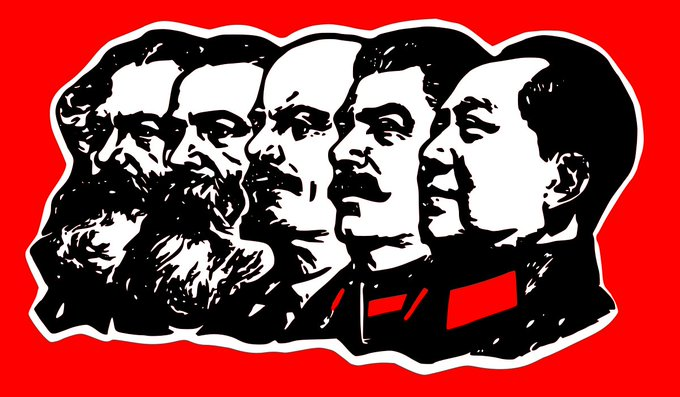
Crimes against humanity under communist regimes were committed against tens of millions worldwide in the twentieth century. https://communistcrimes.org/en/wikipedia-article-mass-killings-under-communist-regimes-faces-deletion-due-neutrality-concerns
Economically, central planning caused inefficiencies, shortages, and stagnation. e.g., Soviet chronic scarcities, Maoist failures ignoring market signals. Authoritarianism suppressed dissent, eroding freedoms and fostering repression. Benefits like inequality reduction were theoretical; implementations fell short, often worsening poverty and innovation. Hegel’s state-centrism, inverted by Marx, risked elitism and neglect of individual rights, justifying oppression. Communism eroded personal moral autonomy, reducing individuals to mere instruments of the state, while its pursuit of rapid, unregulated industrialisation caused severe environmental destruction.
How the Manifesto’s Ideas Warped into New Ideologies
The Manifesto’s economic focus evolved post-World War I failures, shifting to cultural dimensions via Neo-Marxism (or Western Marxism). Antonio Gramsci (1891-1937) emphasised “cultural hegemony,” advocating infiltration of institutions for a “long march” to reshape consciousness.
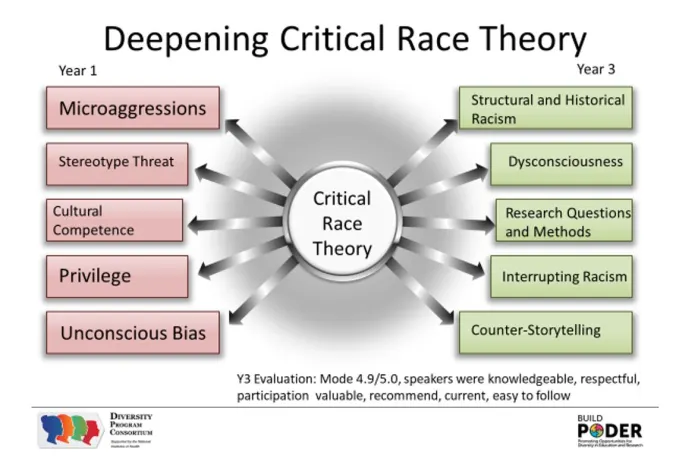
The Frankfurt School (e.g., Herbert Marcuse, Theodor Adorno) critiqued capitalism’s cultural oppression, blending Marxism with Freudianism and existentialism. By the 1960s the “New Left”, this became Cultural Marxism, prioritising identity-based struggles (race, gender, sexuality) over class. Neo-Marxism retains socialist aims but approaches via culture, influencing Critical Theory, Critical Race Theory (CRT), and DEI initiatives. It views Western culture as oppressive, promoting narratives of systemic racism/sexism to dismantle hierarchies. Critics argue this “warps” Marxism into divisive identity politics, fostering grievances without economic revolution. Modern offshoots include Maoism, Marxism-Leninism, and Trotskyism, with global adaptations in developing worlds.
Conclusion, Final Thoughts
The Manifesto’s vision of a classless society achieved through revolutionary seizure of power and the dictatorship of the proletariat led to the establishment of authoritarian states that suppressed individual freedoms, political dissent, and human rights on an unprecedented scale. Regimes claiming inspiration from Marxist principles, most notably the Soviet Union under Lenin and Stalin, Maoist China, Pol Pot’s Cambodia, and others, resulted in mass atrocities, including executions, forced labour camps, deportations, and engineered famines. Economically, the Manifesto’s advocacy for abolishing private property and centralising production under state control proved disastrously inefficient. Without market mechanisms like price signals, incentives for innovation, or individual initiative, Marxist-inspired systems generated chronic shortages, stagnation, and waste.
Beyond direct human and economic costs, the Manifesto’s ideas fostered authoritarian tendencies by justifying “despotic inroads” into society during the transition to communism, as Marx and Engels themselves described. The document’s deterministic view of history; portraying capitalism’s inevitable collapse and communism’s triumph, discouraged nuance, compromise, innovation or reform, instead promoting revolutionary violence and ideological purity that often devolved into totalitarianism.
Its proposed solutions proved far more destructive than the problems it sought to address. The 20th century’s communist experiments left a legacy of devastation: millions dead, economies ruined, cultures suppressed, and generations scarred by repression. The document’s enduring negative impact lies in how its utopian promises, when pursued with ideological zeal, unleashed horrors that overshadowed any theoretical benefits, serving as a stark warning about the dangers of radical ideologies that prioritise collective ends over individual humanity.
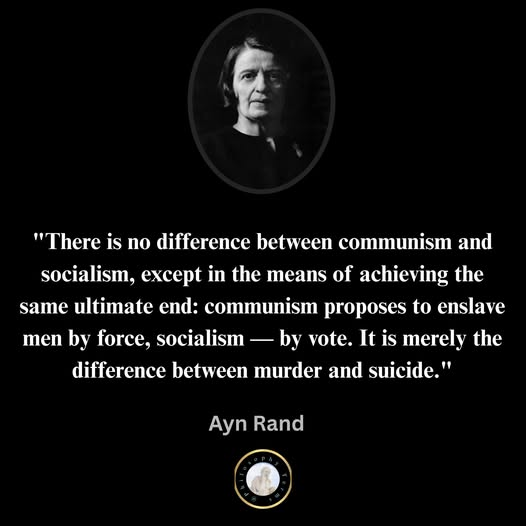
Ayn Rand, a philosopher known for developing Objectivism, was a staunch critic of both communism and socialism. In this quote, she asserts that both ideologies aim for the same “ultimate end.” While she doesn’t explicitly state what that end is within this quote, in her broader philosophy, she viewed both as systems that prioritize the collective over the individual, leading to a suppression of individual rights, freedom, and achievement. https://partiallyexaminedlife.com/2013/06/14/topic78-ayn-rand/
Additional Sources & References
- Boyer, G. R. (1998) ‘The Historical Background of the Communist Manifesto’, Journal of Economic Perspectives, 12(4), pp. 151-174.
- Britannica (2025) The Communist Manifesto. Available at: https://www.britannica.com/topic/The-Communist-Manifesto (Accessed: 21 February 2026).
- Custred, G. (2026) ‘Marxism in America’, Academic Questions, 35(1).
- Dworkin, D. (1997) Cultural Marxism in Postwar Britain: History, the New Left, and the Origins of Cultural Studies. Durham: Duke University Press.
- Gabriel, M. (2011) ‘The private life of Karl Marx’, Salon, 18 September. Available at: https://www.salon.com/2011/09/18/love_and_capital_mary_gabriel (Accessed: 21 February 2026).
- Gonzalez, M. and Netto, J. P. (2026) ‘How Cultural Marxism Threatens the United States—and How Americans Can Fight It’, Heritage Foundation Special Report. Available at: https://www.heritage.org/progressivism/report/how-cultural-marxism-threatens-the-united-states-and-how-americans-can-fight (Accessed: 21 February 2026).
- Grunge (2021) ‘The Untold Truth Of Karl Marx’, 1 November. Available at: https://www.grunge.com/648011/the-untold-truth-of-karl-marx (Accessed: 21 February 2026).
- Harcourt, B. E. (2025) ‘The Communist Manifesto: An Introduction to Marx 6/13’, The 13/13 Seminar. Available at: https://the1313.law.columbia.edu/2025/01/21/bernard-e-harcourt-the-communist-manifesto-an-introduction-to-marx-6-13 (Accessed: 21 February 2026).
- History.com Editors (2025) ‘Karl Marx publishes Communist Manifesto’, HISTORY. Available at: https://www.history.com/this-day-in-history/february-21/marx-publishes-manifesto (Accessed: 21 February 2026).
- Intellectual Takeout (2017) ‘Karl Marx Was a Pretty Bad Person’, 15 February. Available at: https://intellectualtakeout.org/2017/02/karl-marx-was-a-pretty-bad-person (Accessed: 21 February 2026).
- Karl Marx and Frederick Engels – Manifesto of the Communist Party and its genesis Published by the Marxists Internet Archive https://drive.google.com/file/d/186U6J1xdFIsbBpEX14dCGsxDC3KvKyEc/view?usp=sharing
- Kellner, D. (2006) ‘Cultural Marxism and Cultural Studies’, UCLA. Available at: https://pages.gseis.ucla.edu/faculty/kellner/essays/culturalmarxism.pdf (Accessed: 21 February 2026).
- Kengor, P. (2020) The Devil and Karl Marx. Tan Books.Martin, J. (2023) ‘Antonio Gramsci’, Stanford Encyclopedia of Philosophy. Available at: https://plato.stanford.edu/entries/gramsci (Accessed: 21 February 2026).
- Marx, K. and Engels, F. (1848) Manifesto of the Communist Party. London: Communist Workers’ Educational Association. Available at: https://www.marxists.org/archive/marx/works/1848/communist-manifesto/ (Accessed: 21 February 2026).
- Marxist.com [Classics] Manifesto of the Communist Party https://marxist.com/classics-manifesto-of-the-communist-party.htm (Accessed: 21 February 2026).
- Muehlenberg, B. (2014) ‘Cultural Marxism’, CultureWatch, 28 June. Available at: https://billmuehlenberg.com/2014/06/28/cultural-marxism (Accessed: 21 February 2026).
- Nicolaievsky, B. and Maenchen-Helfen, O. (1936) Karl Marx: Man and Fighter. Philadelphia: Lippincott.
- Pop-Eleches, G. and Tucker, J. A. (2017) Communism’s Shadow: Postcommunist Legacies and Contemporary Political Behavior. Princeton: Princeton University Press.
- Schroyer, T. (1973) The Critique of Domination: The Origins and Development of Critical Theory. New York: George Braziller.
- The School of Life (2026) ‘Karl Marx’, Available at: https://www.theschooloflife.com/article/the-great-philosophers-karl-marx (Accessed: 21 February 2026).
- Victims of Communism Foundation (2023) ‘The Birth of the Communist Manifesto’, 21 February. Available at: https://victimsofcommunism.org/the-birth-of-the-communist-manifesto (Accessed: 21 February 2026).
- Wikipedia Contributors (2026) ‘The Communist Manifesto’, Wikipedia. Available at: https://en.wikipedia.org/wiki/The_Communist_Manifesto (Accessed: 21 February 2026).