

In a system meant to support the most vulnerable children, UK local authorities are instead pouring taxpayer money into legal fights they almost always lose. Recent analyses reveal that councils in England and Wales are spending over £150 million annually on special educational needs and disabilities (SEND) tribunals, despite a staggering 99% loss rate. This not only highlights chronic inefficiencies but also exacerbates the suffering of families desperately seeking essential support for their children. As appeals surge and costs spiral, the question arises: why persist with a strategy that drains resources and delays help? This article delves into the background of the SEND system, the escalating financial burden, the reasons behind councils’ tactics, and the urgent calls for reform.

Understanding the SEND System
The SEND framework in the UK is designed to ensure children and young people with special educational needs receive tailored support. At its core are Education, Health and Care Plans (EHCPs), legal documents outlining a child’s needs, the provision required, and the responsible placement, such as specialist schools or therapies. Local authorities are obligated to assess and provide these plans under the Children and Families Act 2014. However, when councils deny assessments, under-provide support, or refuse appropriate placements, parents can appeal to the First-tier Tribunal (Special Educational Needs and Disability), an independent body that reviews decisions.
The system has seen explosive growth: nearly 1.7 million children in the UK now receive SEND support, with the proportion doubling over the past decade. EHCP numbers have risen by nearly 80% since 2018, from under 3% to over 5% of pupils. This surge is attributed to increased awareness, rising diagnoses (e.g., autism and ADHD), and inadequate mainstream school provisions. Yet, funding hasn’t kept pace, leading to a “crisis” where high-needs spending has increased by over £4 billion in real terms since 2018, absorbing more than half of additional school funding.
The Surge in Appeals and Tribunal Outcomes
Appeals have reached record levels, reflecting widespread dissatisfaction with council decisions. In the 2023/24 academic year, 21,000 SEND appeals were registered, a 55% increase from the previous year. Of these, 59% concerned EHCP contents, while 27% challenged refusals for initial assessments. New cases jumped from 13,083 in the year to June 2023 to 20,102 by June 2024, creating a backlog of over 9,000 cases.
Councils’ success rate is abysmal: in 2023/24, local authorities won just 1.3% of cases, the lowest on record, meaning parents prevailed in 98.7% of decided appeals. This trend persists: in 2022/23, councils lost 98% of tribunals, and over the past decade, the figure has hovered around 96-99%. Despite this, appeals have quadrupled in ten years, with 17,000 disposed of in 2023/24 alone.
The Staggering Financial Costs
The financial toll is immense. In 2023/24, councils allocated an estimated £153 million to defend appeals, with total public sector costs exceeding £165 million for the academic year.
Over the last decade, this has amounted to more than £600 million wasted on lost battles. Earlier figures from 2022/23 show £99.2 million spent by local authorities, plus £7.3 million in tribunal fees to the Department for Education (DfE). Pro Bono Economics estimates that including settled cases pushes annual costs to £80-£100 million.
These funds could be transformative: £150 million could fund over 26,000 additional SEND school places. Instead, councils face mounting deficits, with cumulative high-needs overspends projected at £8 billion by March 2027. The government has extended a “statutory override” to keep these off council books until 2028, averting immediate collapse but delaying inevitable bailouts. SEND transport costs alone have ballooned from £644 million in 2015/16 to £1.7 billion in 2023/24. Overall, SEND spending is forecast to hit £21 billion by 2029.
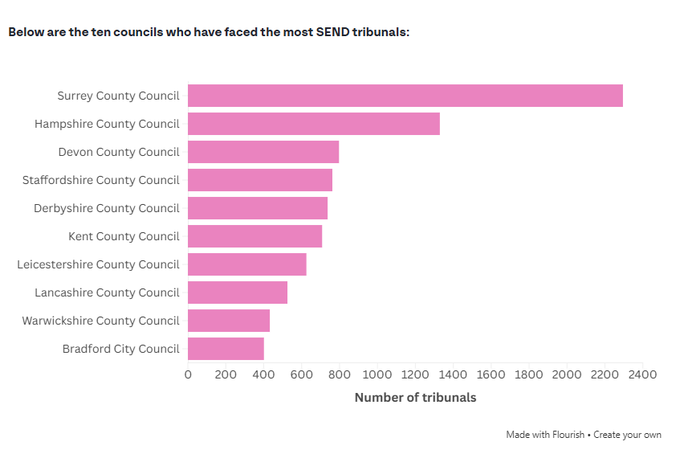
Additional analysis from ITV News reveals that councils spent more than £10 million fighting tribunals over special needs support, with upwards of £13.1 million on associated costs across more than 80 councils over the three financial years from 2021/22 to 2023/24. Individual high spenders included Kent County Council (over £2 million), Warwickshire (£1 million+), and Cambridgeshire (£910,000), underscoring the localised impact amid soaring appeals (from 3,571 in 2021/22 to 6,971 in 2023/24).

Why Councils Persist: Tactics and Criticisms
Experts attribute councils’ dogged defence to systemic pressures. Chronic underfunding forces local authorities to “ration” support, challenging requests to manage budgets. Tribunals are seen as a “delay tactic,” deterring families through intimidation and hoping some abandon appeals. The Tribunal Procedure Committee has implied councils prolong cases to save money by withholding support. IPSEA, a SEND legal charity, accuses authorities of “routinely and unlawfully” denying entitlements. Critics like the Public Accounts Committee describe the system as “inconsistent, inequitable, and unaffordable,” undermining parental confidence. Councils must implement tribunal decisions, even if unsustainable, exacerbating deficits. Some concede just before hearings, but failures to comply persist. Parents report being “gaslit,” with processes likened to a “PhD thesis” and waits extending to 91 weeks.
The Human Impact on Families
Beyond finances, the toll on families is profound. Parents face legal bills of £25,000-£30,000, re-mortgaging homes, and emotional exhaustion. Children endure delays, missing education, and health crises—some hospitalised from stress. One parent described the system as a “war-footing,” with councils deterring appeals to cut costs. Charities note that many families give up, especially those without resources, leading to a “lost generation.”
Calls for Urgent Reform
Reform is imperative. The government has allocated £3 billion for 50,000 specialist places and early interventions. Education Secretary Bridget Phillipson acknowledges the “adversarial” system, with a SEND White Paper expected. Proposals include statutory school responsibilities and potential eligibility limits. Advocates like Special Needs Jungle call for ending “indefensible” defences, redirecting funds to support. The Local Government Association urges mainstream education to reduce transport and tribunal costs.
Conclusion
The SEND tribunal scandal epitomises a broken system: councils waste vast sums on near-certain defeats, while children and families suffer. With appeals at all-time highs and costs unsustainable, reform must prioritise funding, compliance, and collaboration over confrontation. Redirecting resources from courtrooms to classrooms could transform outcomes for vulnerable children, ensuring the system fulfils its promise rather than perpetuating injustice.
References
- Disabled Children’s Partnership (n.d.) Wasting money, wasting potential – our new report. Available at: https://disabledchildrenspartnership.org.uk/news/wasting-money-wasting-potential-our-new-report (Accessed: 15 January 2026).
- Education Law Solicitors (2025) SEND Tribunal Statistics. 24 January. Available at: https://www.educationlawadvice.com/2025/01/24/send-tribunal-statistics (Accessed: 15 January 2026).
- Guardian, The (2024a) Parents trapped in special needs tribunal backlog as disputes surge by 50%. 27 October. Available at: https://www.theguardian.com/education/2024/oct/27/parents-trapped-in-special-needs-tribunal-backlog-as-disputes-surge-by-50 (Accessed: 15 January 2026).
- Guardian, The (2024b) £100m spent in England on failed efforts to block children’s Send support. 22 December. Available at: https://www.theguardian.com/uk-news/2024/dec/22/100m-spent-in-england-on-failed-efforts-to-block-childrens-send-support (Accessed: 15 January 2026).
- Institute for Fiscal Studies (2025) England’s SEND crisis: costs, challenges and the case for reform. 12 September. Available at: https://ifs.org.uk/articles/englands-send-crisis-costs-challenges-and-case-reform (Accessed: 15 January 2026).
- ITV News (2025) Councils spent more than £10m fighting tribunals over special needs support. 13 March. Available at: https://www.itv.com/news/2025-03-13/councils-spent-more-than-10m-fighting-tribunals-over-special-needs-support (Accessed: 15 January 2026).
- LBC (n.d.) Councils spend £150m fighting SEND parents in court – despite losing 99% of cases. Available at: https://www.lbc.co.uk/article/councils-send-cases-parents-schools-5HjdQgw_2/ (Accessed: 15 January 2026).
- Local Government Association (n.d.) Local Government Association response to the Department for Education’s SEND reform national conversation. Available at: https://www.local.gov.uk/parliament/briefings-and-responses/local-government-association-response-department-educations-send (Accessed: 15 January 2026).
- Professional Social Work (2024) Councils continue to fight SEND appeals despite losing most cases at tribunal. 31 January. Available at: https://basw.co.uk/about-social-work/psw-magazine/articles/councils-continue-fight-send-appeals-despite-losing-most (Accessed: 15 January 2026).
- Pro Bono Economics (2023) Wasting money, wasting potential: The cost of SEND tribunals. 19 September. Available at: https://pbe.co.uk/publications/wasting-money-wasting-potential-the-cost-of-send-tribunals (Accessed: 15 January 2026).
- Special Needs Jungle (2024) 55% rise in 2024 SEND Tribunal appeals. LAs’ 1.3% success rate cost £153m. The cost to families? Incalculable. 13 December. Available at: https://www.specialneedsjungle.com/55-rise-2024-send-tribunal-appeals-cost-families-incalculable (Accessed: 15 January 2026).